
Kalman Filter
A Kalman filter is a mathematical method used to estimate the motion state of a target as reliably as possible from measurements containing errors. In radar target tracking, successive measured target positions are processed to estimate the target's current position and velocity in particular. The filter also predicts where the target is likely to be at the time of the next radar measurement.
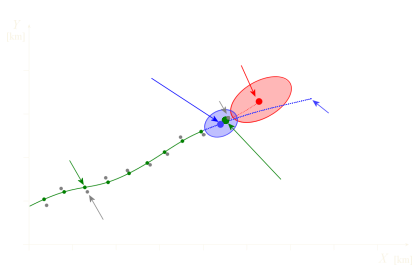
target path
Figure 1: Prediction and correction of target position using a Kalman filter
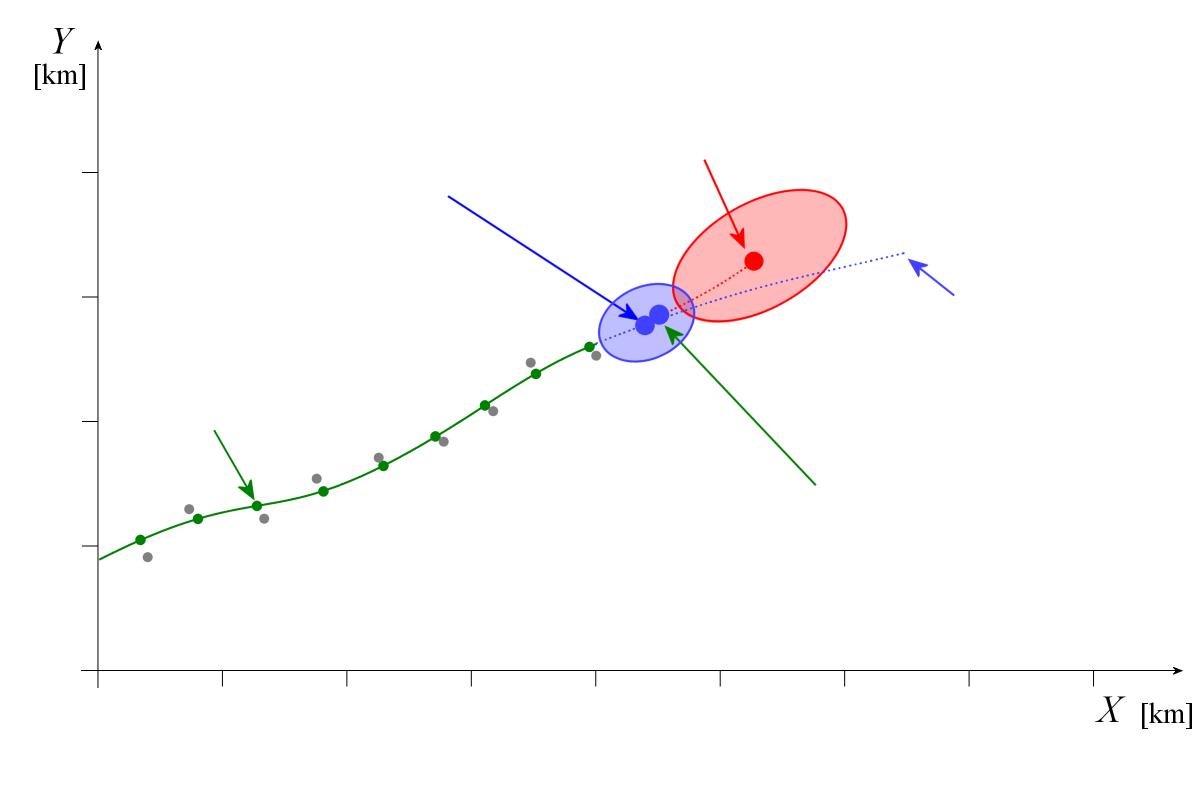
target path
Figure 1: Prediction and correction of target position using a Kalman filter
target path
Figure 1: Prediction and correction of target position using a Kalman filter (interactive image)
Prediction and correction
The Kalman filter repeats two processing steps whenever a new radar measurement becomes available. First, it uses the previously estimated motion state to calculate the prediction for the next measurement time. When a new measurement arrives, the filter compares it with the prediction and performs a correction of the estimated position and velocity.
The new estimate is not simply the arithmetic mean of the measurement and the prediction. Instead, the filter considers how uncertain each value is. Uncertainty describes how far the target's actual position may deviate from the measured or predicted position because of measurement errors or an imperfect motion model. If the radar measurement is inaccurate, the prediction receives greater weight. Conversely, if the prediction is uncertain, the new measurement has a greater influence on the result.
A simple example: the filter predicts that a target is at a range of 10.2 km, but the radar measures 10.0 km. In this simplified example, the corrected range lies between the two values. How close it is to the measurement or the prediction depends on their respective uncertainties.
How does the filter account for measurement errors?
Radar measurements contain errors caused, among other things, by limited measurement accuracy and noise. The prediction is not exact either, because the motion model can only approximate the target's actual motion. Therefore, in addition to the estimated motion quantities, the Kalman filter maintains information about their uncertainties. These are mathematically represented by a covariance matrix, which describes both the spread of estimation errors and possible correlations between them.
The uncertainties of the prediction and the measurement determine how strongly the new measurement is taken into account during the correction. After each correction, the filter also updates the estimated uncertainty. This updated uncertainty then serves as the starting point for the next prediction.
What happens when a target maneuvers?
If a target moves approximately as assumed by the motion model, the Kalman filter can estimate its position and velocity very reliably. However, if the target suddenly changes course or speed, its measured position may differ significantly from the prediction. The filter cannot anticipate such an unexpected maneuver and can only respond to it using new measurements.
How quickly the filter responds depends, among other things, on the assumed uncertainty of the motion model. If too much confidence is placed in the model, the estimates may be smooth, but the filter may respond too slowly to maneuvers. In addition, a measurement that falls far outside the expected region may be rejected during track association. Choosing the filter parameters therefore involves a trade-off between a smooth target track and rapid adaptation to changes in target motion.
Importance for radar target tracking
The Kalman filter estimates the target's motion state and predicts its next position. This prediction can be used to define the region in which the next radar measurement is expected. However, determining which radar plots belong to which target is the task of data association, not of the Kalman filter alone. Continuous state estimation must also be distinguished from subsequent track smoothing, in which later measurements can also be used to improve earlier estimates.
The method operates recursively. For the next calculation, it needs only the previous state estimate, its uncertainty, and the newly associated measurement. It does not have to process all previous measurements again during every radar scan. This makes the Kalman filter well suited for automatic target tracking in real time.
References:
- Alex Becker: „Kalman-Filter from de ground up“ 2023, ISBN 9789659312009