
Holographic Radar Imaging

light
wave
wave
transparent
mirror
Figure 1: Principle of holographic recording

light
wave
wave
transparent
mirror
Figure 1: Principle of holographic recording
What Is Holographic Radar?
Holographic Radar Imaging
The development of high-performance computers now makes holographic radar imaging possible. In this process, coherently received radar signals are evaluated so that their amplitudes and phases can provide information about the spatial distribution of reflecting objects. Radar techniques that use principles similar to those of optical holography are also referred to as holographic radar. However, this term covers several different technical approaches and is not limited to a single operating principle.
Unlike conventional optical holography, these techniques do not necessarily involve recording an optical hologram. Instead, spatial information is reconstructed from coherent measurements through digital signal processing. Therefore, the use of a coherent receiver alone does not make a radar system holographic.
Holographic Image Processing
The principle of optical holography (see Figure 1) is based on the interference of coherent light waves, which are usually generated by a laser. A partially transparent mirror divides the laser light into a reference wave and an illumination wave. The illumination wave strikes the object to be imaged. Light reflected or scattered by the object forms what is known as the object wave. At the surface of the holographic film, the object wave and the reference wave overlap. The resulting interference pattern contains information about the amplitudes and relative phases of the two waves.
After development, the film initially shows no recognizable image of the object to the human eye. Instead, it contains a fine interference pattern consisting of microscopic structures. When the hologram is illuminated with a suitable reconstruction wave, light is diffracted by these structures, producing a wave corresponding to the original object wavefront. The observer therefore sees a three-dimensional image, as though looking at the object through a window. Within certain limits, the reconstructed object can even be viewed from different angles.
Holographic Radar Imaging
The basic functions of a holographic measurement arrangement can be implemented in radar technology using electronic components. Instead of coherent laser light, a frequency-stable, phase-coherent signal source is used. The function of the partially transparent mirror can be performed by a power divider or directional coupler. The “reference wave” corresponds to the portion of the oscillator signal that remains within the radar equipment and is used as a reference for demodulation. The “illumination wave” corresponds to the transmitted signal, which is amplified and radiated by an antenna. The echo signal reflected from a target takes the role of the “object wave.”
To determine the relative phase, the echo signal can be mixed in an I&Q demodulator with two reference signals whose phases differ by 90°. The two resulting output components can be used to determine the amplitude and relative phase of the received signal. This information can then be used for coherent spatial signal processing.
The basic electronic components needed for this process are available in many modern radar systems, regardless of whether they are pulse radars or continuous-wave radars. However, holographic radar imaging additionally requires measurements containing different spatial information, which must be processed using suitable algorithms.
Short-Range Holographic Radar

Figure 2: RASCAN-5 Ground-Penetrating Radar

Short-range holographic radar systems are used, for example, as ground-penetrating radar (GPR) or for contactless inspection of people and objects in security applications. They can operate at several fixed transmit frequencies and evaluate the phases of the reflected waves. The RASCAN-5 shown in Figure 2 uses several discrete transmit frequencies for this purpose. Measurements are performed using continuous-wave radar, with the transmit frequency switched in steps. This principle is related to frequency-shift keying (FSK).
For a given distance, different transmit frequencies produce different phases in the reflected signals. Joint evaluation of these measurements can reduce ambiguities. It can also reveal objects that would produce only weak responses, or might not be detected at all, at a single frequency because of unfavorable interference conditions. Measurements are acquired sequentially at different antenna positions. For this purpose, a single antenna can be moved in a controlled manner across the surface being examined. Alternatively, individual elements of an antenna array can be selected sequentially using an antenna switch.
The term holographic radar imaging refers to the reconstruction of the spatial distribution of reflecting structures from coherent measurements. The phase information of the received signals plays an essential role in this process. However, sequential acquisition of the measurements limits the possible image update rate. Whether images can be displayed in real time depends on the scanning speed and the available processing power.
Holographic ground-penetrating radar imaging provides detailed representations of structures near the surface or concealed within a material. The achievable penetration depth depends particularly on the transmit frequency and the electrical and dielectric properties of the material being examined. Consequently, there is often a trade-off between high spatial resolution and greater penetration depth.[2]
Different techniques are described as holographic in radar technology. In holographic ground-penetrating radar imaging, phase information obtained at different antenna positions is used to reconstruct the spatial distribution of concealed objects. Holographic surveillance radars, by contrast, can use stationary antenna arrays and digital beamforming to monitor a larger volume of space simultaneously. Both approaches use coherent measurements, but differ in their hardware configurations and subsequent signal processing techniques.
Holographic Radar for Surveillance and Reconnaissance
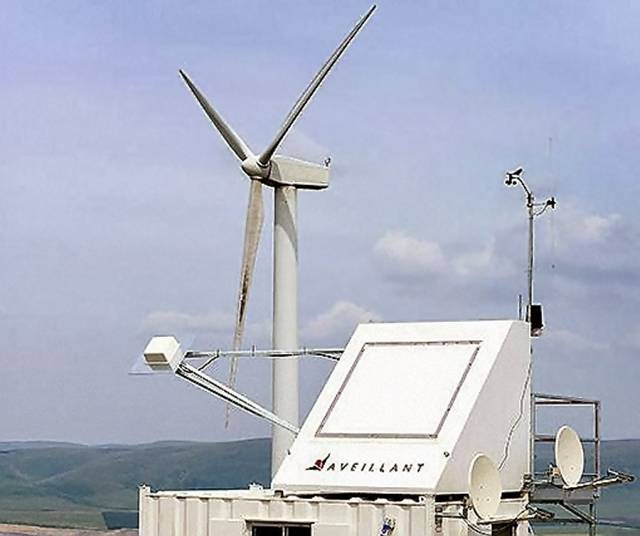
Figure 3: Holographic Radar™ [1]
In the Holographic Radar™ system described here, developed by Aveillant, spatial information is obtained differently than in an optical hologram. Instead of recording an interference pattern on photographic film, signals from numerous receiving channels are digitized and processed together. For this purpose, the radar uses a stationary phased-array antenna with digital beamforming on the receiving side. The volume of space under surveillance is illuminated by the transmitted radar energy, while the received signals from numerous individual antenna elements are digitized separately. From these data, the signal processor can calculate many independent receive antenna patterns and thus detect targets in different spatial directions simultaneously.
Because no mechanical antenna movement is required, the assigned surveillance volume can be evaluated much more frequently than with a conventional rotating parabolic antenna. While a rotating surveillance radar revisits a particular sector only once per antenna revolution, certain versions of Holographic Radar™ can update the same sector up to four times per second. This simplifies target tracking because the target is illuminated more frequently and its current position can be updated more often. Target movements can therefore be recognized more easily, without having to associate each new detection with a target position recorded several seconds earlier.
Clutter from stationary objects can be suppressed more effectively by spatially separating the received signals and analyzing their Doppler frequencies. Interference caused by rotating wind turbines can also be identified and reduced more selectively through high spatial resolution and detailed Doppler analysis. However, moving turbine blades generate Doppler shifts of their own, making this type of interference difficult to suppress completely under all conditions.
Simultaneously processing signals from numerous receiving channels and calculating a large number of independent antenna patterns requires substantial digital computing power. The actual computational workload depends, among other factors, on the number of receiving channels, the signal bandwidth, the number of receive beams being formed, and the algorithms used.
Sources and Further Reading:
- “Holographic Radar™” is a trademark of Aveillant Ltd. (United Kingdom).
- James D. Taylor: “Ultrawideband Radar. Applications and Design,” CRC Press, 2012, ISBN 9781420089868, p. 421 (online preview)