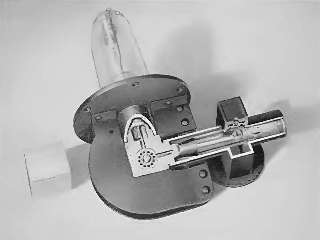
AN/APQ-10
Description of the radar set, tactical-technical characteristics


| Specifications | |
|---|---|
| frequency: | 9 375 MHz
(X band) |
| pulse repetition time (PRT): | |
| pulse repetition frequency (PRF): | |
| pulsewidth (τ): | |
| receiving time: | |
| dead time: | |
| peak power: | 30 kW |
| average power: | |
| instrumented range: | 50 NM (≙ 92 km) |
| range resolution: | |
| accuracy: | |
| beamwidth: | |
| hits per scan: | |
| antenna rotation: | |
| MTBCF: | |
| MTTR: | |
AN/APQ-10
The AN/APQ-10 was a search, navigation, and bomb-guidance radar developed during World War II for the Boeing B-29 Superfortress, operating in the X band (IEEE designation) or in the I band (NATO designation). It was developed by Bell labs and Massachusetts Institute of Technology Radiation Lab, and Western Electric until 1944 and was the predecessor of the AN/APQ-13.
The radar used a parabolic antenna mounted in a radome on the underside of the B-29's fuselage between the landing gear. The transmitter used a Western Electric 725A magnetron.