ASC-1
Description of the radar set, tactical-technical characteristics

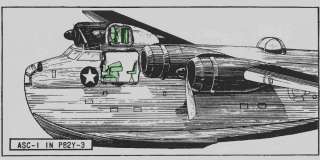
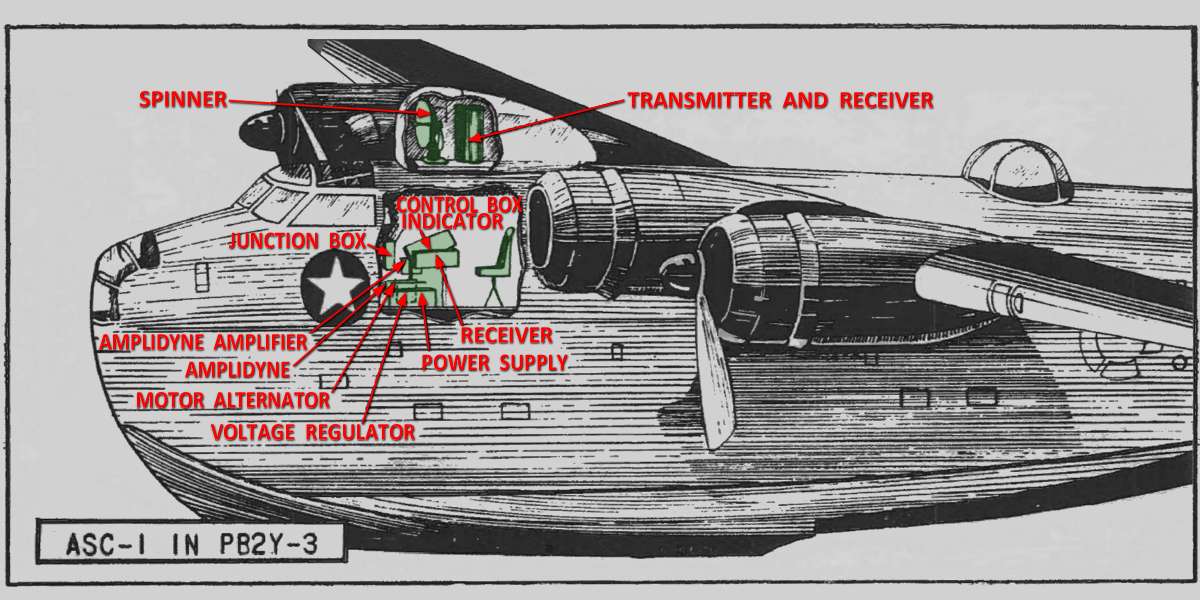
Figure 1: ASC-1 in PB2Y-3


| Specifications | |
|---|---|
| frequency: | 3 GHz
(S band) |
| pulse repetition time (PRT): | |
| pulse repetition frequency (PRF): | |
| pulsewidth (τ): | |
| receiving time: | |
| dead time: | |
| peak power: | |
| average power: | |
| instrumented range: | 90 mi (≙ 145 km) |
| range resolution: | |
| accuracy: | ± 3% |
| beamwidth: | 6° |
| hits per scan: | |
| antenna rotation: | |
| MTBCF: | |
| MTTR: | |
ASC-1
The ASC-1 (later variants named SCR-517) was an airborne surveillance radar operating in the S band (IEEE designation) or in the E/F band (NATO designation) for installation in patrol bombers. The ASC-1 and the SCR-517-B modification used a PPI scope with a 360° panorama view. The SCR-517-A and SCR-517-C were equipped with a B scope and were used in 180° sector mode.
The ASC-1 was installed in the PB2Y-3 in the second half of 1942. SCR-517-A and SCR-517-C were installed in B-17, B-18, B-25, and B-34 planes. SCR-517-B was installed in B-24.