
SCR-296
Description of the radar set, tactical-technical characteristics
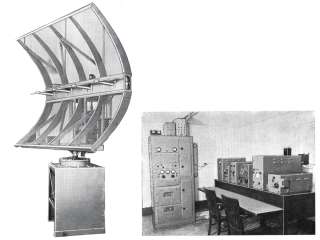
Figure 1: SCR-296


| Specifications | |
|---|---|
| frequency: | 700 MHz
(UHF band) |
| pulse repetition time (PRT): | |
| pulse repetition frequency (PRF): | |
| pulsewidth (τ): | |
| receiving time: | |
| dead time: | |
| peak power: | |
| average power: | |
| instrumented range: | 100 NM (≙ 185 km) |
| range resolution: | |
| accuracy: | |
| beamwidth: | |
| hits per scan: | |
| antenna rotation: | |
| MTBCF: | |
| MTTR: | |
SCR-296
The SCR-296 was a coastal defense radar operating in the UHF band (IEEE designation) or in the UHF band (NATO designation) for detecting surface targets and controlling artillery with calibers of 6 inches or larger. It was developed during World War II in response to the attack on Pearl Harbor and was used to protect major US harbors.
The radar could also be mounted on a tower up to 30 meters high to minimize the effect of Earth's curvature on the maximum range. The range was displayed on an A-scope. The antenna was a single curved parabolic reflector measuring approximately 6 by 6 feet, fed by four half-wave dipoles. The antenna rotated remotely but manually, allowing only a single target to be tracked and engaged at a time.
A modernization by the U.S. Army Signal Corps featured a flicker phase shift to improve side angle measurement accuracy. These versions were designated SCR-296-A.