
AN/SPN-10
Description of the radar set, tactical-technical characteristics
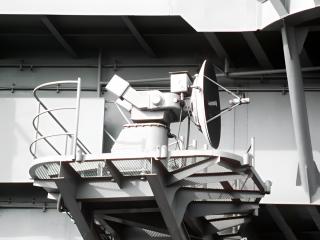
Figure 1: AN/SPN-42


| Specifications | |
|---|---|
| frequency: | 33.14 GHz
(Ka band) |
| pulse repetition time (PRT): | |
| pulse repetition frequency (PRF): | |
| pulsewidth (τ): | |
| receiving time: | |
| dead time: | |
| peak power: | |
| average power: | |
| instrumented range: | 4 NM (≙ 7.5 km) |
| range resolution: | |
| accuracy: | |
| beamwidth: | 0.57° |
| hits per scan: | |
| antenna rotation: | |
| MTBCF: | |
| MTTR: | |
AN/SPN-10
AN/SPN-10 was a computer-controlled approach radar used on American aircraft carriers, operating in the Ka band (IEEE designation) or in the K band (NATO designation).
It comprised two independent radar sets, each with a parabolic antenna, to support the theoretically possible frequency of two landings per minute. The system could operate in three modes: fully automatic, semi-automatic, and manual landing assistance (“talking down”). To improve radar tracking, aircraft were equipped with a small, retractable corner reflector under the nose, which increased the radar cross-section (RCS).
The first installation took place in 1963/63. Although the original system’s conical scan method provided high accuracy, it was quite vulnerable. In 1966 Bell was tasked with making the radar more reliable by incorporating semiconductor technology and extensive digitization. This upgraded system was called the AN/SPN-42 and used the same radar head and antenna.
Later, the system was replaced by the AN/SPN-46, which employed the same operating principle but in a different frequency range, roughly doubling the range.