
Liana
Description of the radar set, tactical-technical characteristics
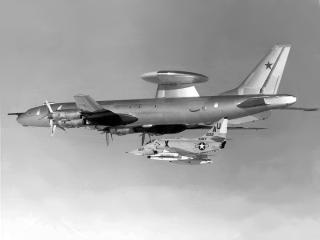
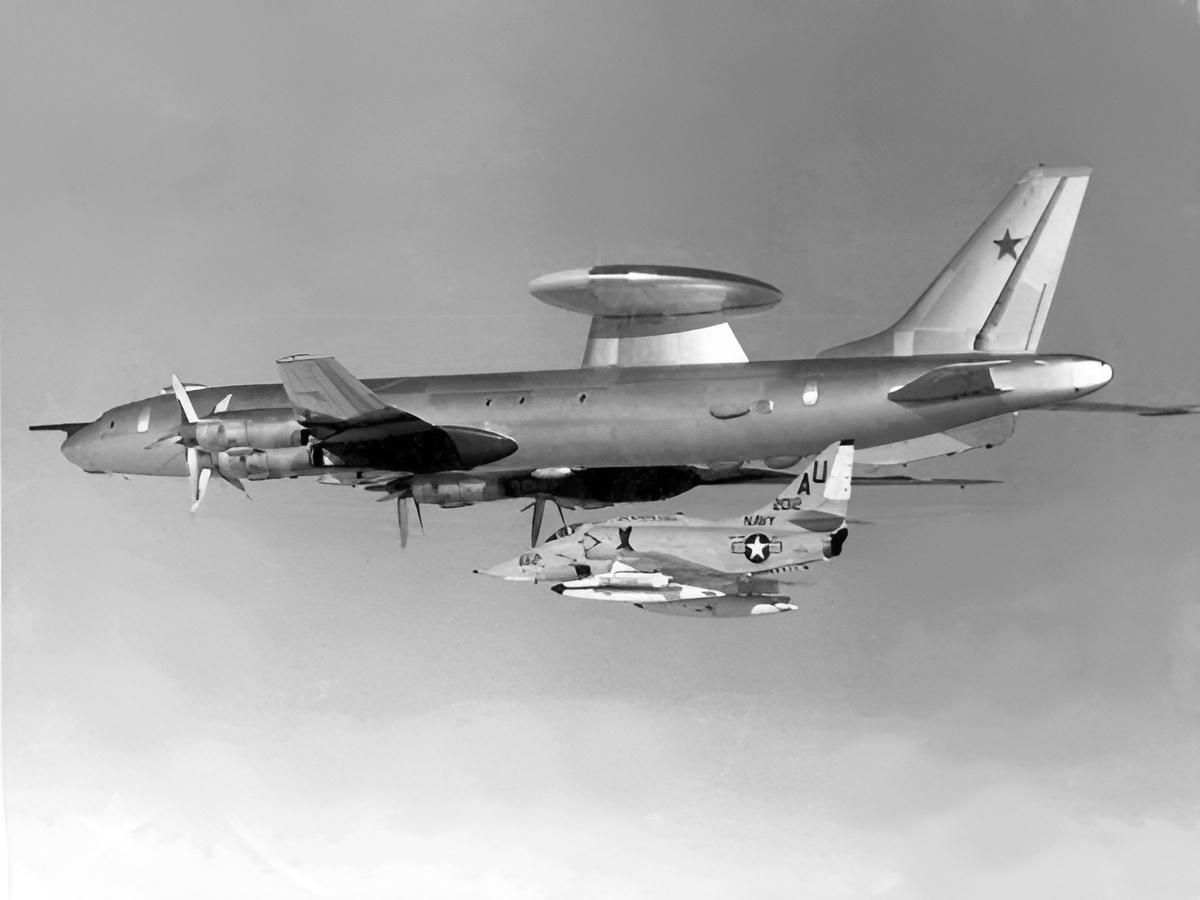
Figure 1: Tupolev Tu-126 with the Liana radar
 Нижегородский
| Specifications | |
|---|---|
| frequency: | S band |
| pulse repetition time (PRT): | |
| pulse repetition frequency (PRF): | 300 Hz |
| pulsewidth (τ): | 4 µs |
| receiving time: | |
| dead time: | |
| peak power: | 2 MW |
| average power: | |
| instrumented range: | 400 km |
| range resolution: | |
| accuracy: | |
| beamwidth: | |
| hits per scan: | |
| antenna rotation: | 10 r.p.m. |
| MTBCF: | |
| MTTR: | |
Liana
The Liana (Cyrillic: РЛС «Лиана») was an airborne early warning radar operating in the S band (IEEE designation) or in the E/F band (NATO designation), which was installed in the early 1960s in the Tupolev Tu-126 (NATO designation: “Moss”), a variant of the Tupolev Tu-114 passenger aircraft. It was developed from the GCI-radar P-30 and could track up to 10 targets.
The antenna, measuring 10 × 1,8 m, rotated inside the rigid lens-shaped radome above the rear fuselage. The correspondingly heavy analog radar electronics consisted of a large number of electron tubes and supplied five workstations for operators. The transmitter operated on the basis of magnetrons. The system for suppressing fixed clutter was to be based on the external coherence method, but proved to be generally unreliable. Weaker moving targets against the background of the Earth’s surface could hardly be detected, which is why missions had to be carried out at lower altitudes.
In May 1964, the prototype of the Tu-126 was unveiled. Eight such surveillance aircraft were manufactured and stationed in the then Lithuanian Soviet Republic. In 1984, the Tu-126s were decommissioned.