Dunay-3
Description of the radar set, tactical-technical characteristics

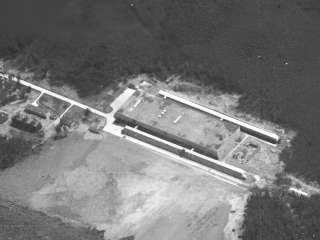
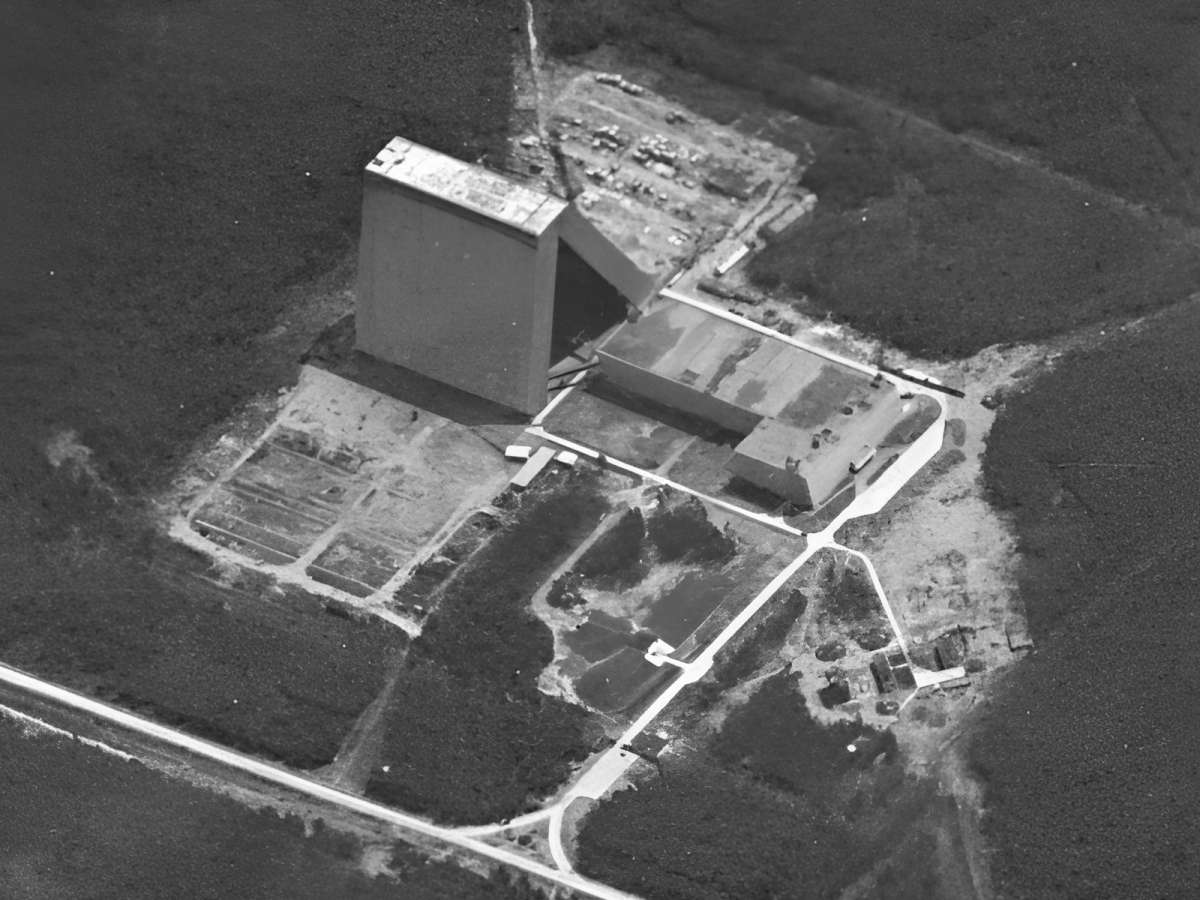
Figure 1: Dunay-3 receiver site
(55°29'31.0" N 36°40'49.0" E)

former Soviet Union
| Specifications | |
|---|---|
| frequency: | 388 … 429 MHz
(UHF band) |
| pulse repetition time (PRT): | |
| pulse repetition frequency (PRF): | |
| pulsewidth (τ): | |
| receiving time: | |
| dead time: | |
| peak power: | 3 MW |
| average power: | |
| instrumented range: | 1 350 NM (≙ 2 500 km) |
| range resolution: | |
| accuracy: | |
| beamwidth: | |
| hits per scan: | |
| antenna rotation: | |
| MTBCF: | |
| MTTR: | |
Dunay-3
The Dunay-3 (Cyrillic: Дунай-3, “Danube-3”, NATO-designator: “Dog House”) was operating in the UHF band (IEEE designation) or in the C band (NATO designation) early warning radar. The site is located at Kubinka (60 km west of Moscow).
The Dunay-3 comprised separate receiver and transmitter buildings, located 2.5 kilometers apart. The transmitter covered two sectors (approximately north and south), featuring a 200-meter-long and 30-meter-high phased-array antenna. The receiver was a 100 × 100 m building housing two passive electronically steered radar systems and the command and control center for the A-35 anti-ballistic missile (ABM) system.
Dunay-3 was an advancement of the Dunay-2 in Kubinka, Moscow, and was commissioned in experimental operation since 1968. After extensive modernization in 1978, it was adopted for service under the designation “Dunay-3M” as part of the upgraded A-35M ABM system. The Dunay-3M was operational until the receiver antenna burned down on May 8, 1988.