
Millstone Hill Radar
Description of the radar set, tactical-technical characteristics
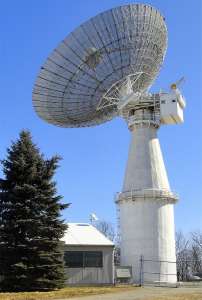
Figure 1: Millstone Hill Radar


| Specifications | ||
|---|---|---|
| initial | update | |
| frequency: | 440,2 MHz
(UHF band) |
1 295 MHz
(L band) |
| pulse repetition time (PRT): | ||
| pulse repetition frequency (PRF): | 40 Hz | |
| pulsewidth (τ): | 1 ms | |
| receiving time: | ||
| dead time: | ||
| peak power: | 5 MW | 3 MW |
| average power: | 120 kW | |
| instrumented range: | 1 000 km | |
| range resolution: | ||
| accuracy: | 5 m; 0.01° | |
| beamwidth: | 0.6° | |
| hits per scan: | ||
| antenna rotation: | ||
| MTBCF: | ||
| MTTR: | ||
Millstone Hill Radar
The Millstone Hill Radar (MHR) is a large (84-foot diameter) operating in the UHF band (later L band) tracking radar located at Millstone Hill in Westford, Massachusetts. It is an important contributing sensor to the Space Surveillance Network (SSN) and is used for both near- and deep-space surveillance. The MHR should not be confused with another radar at the same site, sometimes also called Millstone Hill radar (more precisely: “Millstone Hill Incoherent Scatter Radar,” or “MHR ISR”), which has a 220-foot fixed zenith-pointing antenna and a 150-foot steerable dish antenna. Both radars are operated by the MIT Haystack Observatory Atmospheric Sciences Group.
The Millstone Hill Radar was first constructed as a UHF radar in 1956 as a prototype of BMEWS radar systems. It served as a development model for RCA’s AN/FPS-49, AN/FPS-49A, and AN/FPS-92 radars, all of which were used in the BMEWS. On October 5, 1957 it detected the Soviet Sputnik Ⅰ satellite, just one day after its launch. In 1965, MHR was reconfigured as an L band radar with a new transmitter and a new antenna with the same diameter and a 12-horn monopulse feed. The old UHF transmitter now serves for the “MHR ISR”.