
Dunay-3U
Description of the radar set, tactical-technical characteristics

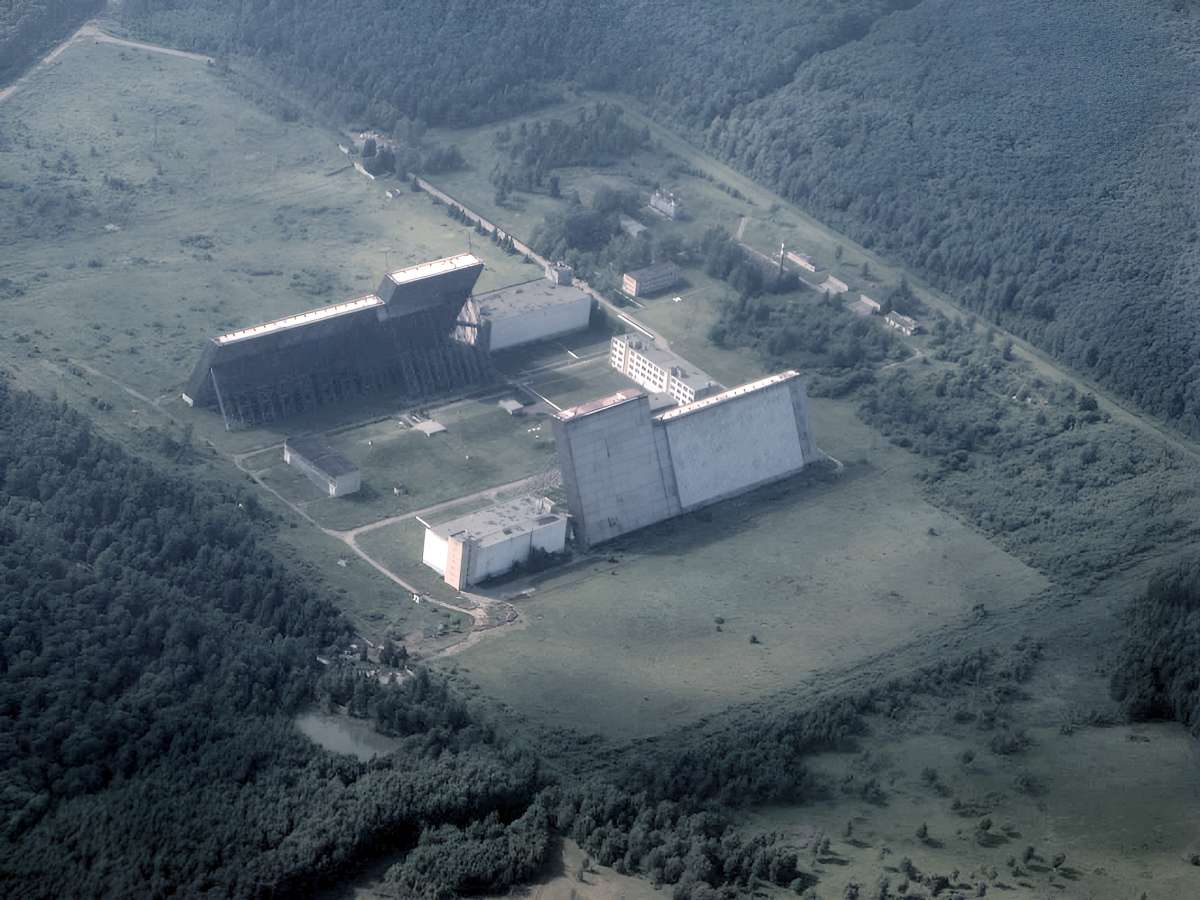
Figure 1: Dunaj-3U, receiver site

former Soviet Union
| Specifications | |
|---|---|
| frequency: | 388 … 429 MHz
(UHF band) |
| pulse repetition time (PRT): | |
| pulse repetition frequency (PRF): | |
| pulsewidth (τ): | |
| receiving time: | |
| dead time: | |
| peak power: | 3 MW |
| average power: | |
| instrumented range: | 1600 NM (≙ 3 000 km) |
| range resolution: | |
| accuracy: | |
| beamwidth: | |
| hits per scan: | |
| antenna rotation: | |
| MTBCF: | |
| MTTR: | |
Dunay-3U
The Dunay-3U (Cyrillic: Дунай-3У, “Danube-3U”, NATO code name: “Cat House”) operated in the UHF band (IEEE designation) or the C band (NATO designation) as an early warning radar similar to the Dunay-3M system. The site is located in Chekhov, Moscow Oblast, and is part of the upgraded A-35M anti-ballistic missile system.
The radar featured separate receiver and transmitter sites that were 2.7 kilometers apart. The transmitter site used two phased-array antennas, which were oriented in nearly opposite directions to cover two sectors. Before 2003, the transmitter was equipped with 30 waveguides, each powered by a 100 kW transmitter. Since 2003, the station has operated at a reduced power of 500 kW, using a single antenna with 12 transmitters. The radar employed intrapulse modulation and pulse compression.
The Dunay-3U was commissioned in May 1978. Since 1995, the radar has been used for satellite surveillance in low Earth orbit.