SCR-717
Description of the radar set, tactical-technical characteristics
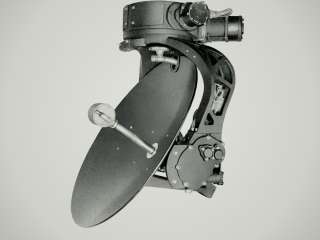
Figure 1: Antenna of SCR-717
 Hersteller:
U.S. Army Signal Corps
| Specifications | |
|---|---|
| frequency: | 3.3 GHz
(S band) |
| pulse repetition time (PRT): | |
| pulse repetition frequency (PRF): | |
| pulsewidth (τ): | 1.2 µs |
| receiving time: | |
| dead time: | |
| peak power: | 40 kW |
| average power: | |
| instrumented range: | 100 NM (≙ 185 km) |
| range resolution: | |
| accuracy: | |
| beamwidth: | |
| hits per scan: | |
| antenna rotation: | |
| MTBCF: | |
| MTTR: | |
SCR-717
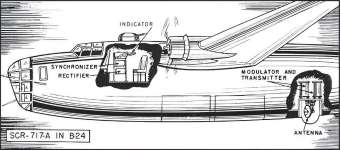
The SCR-717 “Pathfinder” was a navigation radar that could see shorelines, rivers, and cities. It is a further development of the SCR-517. It operated in the S band (IEEE designation) or in the F band (NATO designation). The rotating parabolic antenna was housed in a retractable turret mounted below the C-24 belly. The radar used two PPI scopes to see the terrain around the aircraft.
The SCR-717 was very similar in design to the AN/APS-2, with the difference that the APS-2 used a B-scope.
The radar was developed in mid-1943. The series production was taken over by Westinghouse.