SCR-545
Description of the radar set, tactical-technical characteristics
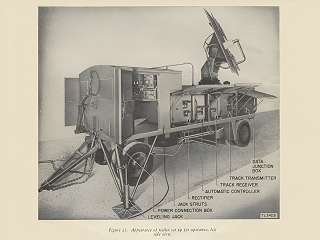
Figure 1: SCR-545


| Specifications | ||
|---|---|---|
| frequency: | 200 MHz
(VHF band) |
3 GHz
(S band) |
| pulse repetition time (PRT): | ||
| pulse repetition frequency (PRF): | ||
| pulsewidth (τ): | ||
| receiving time: | ||
| dead time: | ||
| peak power: | ||
| average power: | ||
| instrumented range: | 50 000 Yards (≙ 46 km) |
|
| range resolution: | ||
| accuracy: | ||
| beamwidth: | ||
| hits per scan: | ||
| antenna rotation: | ||
| MTBCF: | ||
| MTTR: | ||
SCR-545
The SCR-545 was a dual-band fire-control radar operating in the VHF and S bands (IEEE designation) or in the A and E/F bands (NATO designation). The VHF channel was initially used for early warning, and the S band channel for target tracking. However, in practice, both channels could be utilized for target tracking.
The VHF channel employed a 4 × 4 dipole array in front of a common grid reflector, with the parabolic reflector for the S-band channel embedded in its center.
The SCR-545 was introduced around 1944. It was not produced in quantity since the SCR-584, which was already available, provided better results. A British acquisition was planned under the designation AA No. 3 Mk.8 but was never implemented.