
AN/ASG-18
Description of the radar set, tactical-technical characteristics
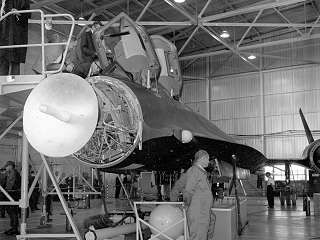
Figure 1: AN/ASG-18 in YF-12A


| Specifications | |
|---|---|
| frequency: | 9 350 … 9 400 MHz
(X band) |
| pulse repetition time (PRT): | |
| pulse repetition frequency (PRF): | 980 … 1 020 Hz |
| pulsewidth (τ): | 0,15 or 0,25 µs |
| receiving time: | |
| dead time: | |
| peak power: | |
| average power: | |
| instrumented range: | 130 NM (≙ 250 km) |
| range resolution: | |
| accuracy: | |
| beamwidth: | |
| hits per scan: | |
| antenna rotation: | |
| MTBCF: | |
| MTTR: | |
AN/ASG-18
AN/ASG-18 was operating in the X band (IEEE designation) or the I band (NATO designation) fully coherent pulse Doppler fire control Radar developed for the North American YF-12A interceptor. The ASG-18 was installed in the extreme long nose of the aircraft, with the forward chines being cut back to accommodate the 40-inch radome. It was to have look down/shoot down capability, but could track only one target at a time and provided target illumination for the semi-active radar mid-course guidance.
ASG-18 had a liquid cooled transmitter, formed from two traveling wave tubes (TWTs) in tandem and analogue circuitry for generating and processing the coherent high PRF waveform. It was fitted with a separate infra-red search and track (IRST) system capable of working cooperatively with the radar. The radar required 40 kVA of power.
Development began in 1954 and the prototype was ready for use in 1958. Only three sets were built because the development of the YF-12A was canceled.