
SCR-520
Description of the radar set, tactical-technical characteristics
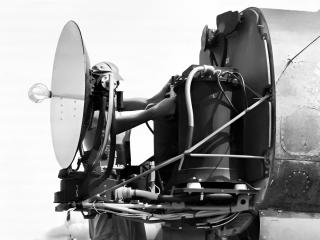
Figure 1: SCR-520


| Specifications | |
|---|---|
| frequency: | 3.3 GHz
(S band) |
| pulse repetition time (PRT): | |
| pulse repetition frequency (PRF): | 1.5 kHz |
| pulsewidth (τ): | 0.75 µs |
| receiving time: | |
| dead time: | |
| peak power: | 3.3 kW |
| average power: | |
| instrumented range: | 10 mi (≙ 16 km) --> |
| range resolution: | |
| accuracy: | |
| beamwidth: | |
| hits per scan: | |
| antenna rotation: | |
| MTBCF: | |
| MTTR: | |
SCR-520
The SCR-520 was an interceptor radar operating in the S band (IEEE designation) or in the F band (NATO designation) for U.S. night fighters during World War II. It was deployed starting in 1944 in aircraft such as the Northrop P-61 Black Widow and the Douglas P-70 Nighthawk.
The radar used a 70-cm symmetrical parabolic antenna and conical scan for target tracking. Target search was performed using a Palmer scan.