
Blue Vixen
Description of the radar set, tactical-technical characteristics
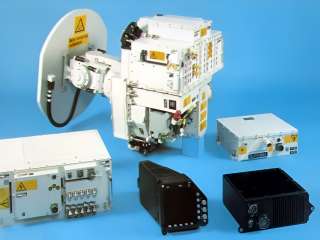
Figure 1: Blue Vixen


| Specifications | |
|---|---|
| frequency: | X band |
| pulse repetition time (PRT): | |
| pulse repetition frequency (PRF): | |
| pulsewidth (τ): | |
| receiving time: | |
| dead time: | |
| peak power: | |
| average power: | |
| instrumented range: | 160 NM (≙ 296 km) |
| range resolution: | |
| accuracy: | |
| beamwidth: | |
| hits per scan: | |
| antenna rotation: | |
| MTBCF: | |
| MTTR: | |
Blue Vixen
Blue Vixen (British Army Designation: ARI 50019) was operating in the X band (IEEE designation) or the I band (NATO designation) multimode, lightweight, coherent pulse-Doppler radar. It served as the primary sensor on board the UK Royal Navy Sea Harrier F/A Mk 2, designed to provide air-to-air and air-to-surface surveillance, target acquisition, and engagement capabilities.
The transmitter's power amplifier uses a traveling wave tube (TWT). The antenna is a mechanical scanning slotted waveguide with a diameter of 60 cm. It covers ± 70° in azimuth and ± 60° in elevation.
The first radar was delivered in 1991. It replaced the aged Blue Fox radar.