
Blue Fox
Description of the radar set, tactical-technical characteristics
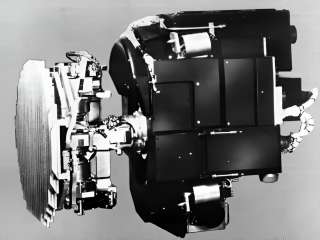
Figure 1: Blue Fox


| Specifications | |
|---|---|
| frequency: | X band |
| pulse repetition time (PRT): | |
| pulse repetition frequency (PRF): | |
| pulsewidth (τ): | |
| receiving time: | |
| dead time: | |
| peak power: | |
| average power: | |
| instrumented range: | 100 NM (≙ 182 km) |
| range resolution: | |
| accuracy: | |
| beamwidth: | |
| hits per scan: | |
| antenna rotation: | |
| MTBCF: | |
| MTTR: | |
Blue Fox
Blue Fox was operating in the X band (IEEE designation) or in the I band (NATO designation) lightweight multimode, coherent airborne interception and fire-control radar for the British Sea Harrier FRS.1. It was mounted in a similarly shaped radome at the nose, which could be folded to the left to reduce the space required on the aircraft carrier.
The antenna is a mechanically scanning flat slotted waveguide that is stabilized in pitch and roll. The display used provides a bright, digital image in raster scan mode.
Blue Fox was operational from January 1979 and was replaced by Blue Vixen in the early 1990s.