
ST-67
Description of the radar set, tactical-technical characteristics
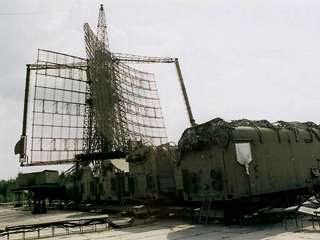
Figure 1: ST-67 “Salyut”


| Specifications | |
|---|---|
| frequency: | L band |
| pulse repetition time (PRT): | |
| pulse repetition frequency (PRF): | |
| pulsewidth (τ): | |
| receiving time: | |
| dead time: | |
| peak power: | |
| average power: | 15 kW |
| instrumented range: | 340 NM (≙ 630 km) |
| range resolution: | |
| accuracy: | |
| beamwidth: | |
| hits per scan: | |
| antenna rotation: | |
| MTBCF: | |
| MTTR: | |
ST-67
ST-67 “Salyut” (Russian designator: 5N69, Cyrillic: СТ-67, 5Н69, «Салют») is operating in the L band long-range 3D air surveillance radar that was incorporated into the armament of the Soviet armed forces in the mid-1970s.
The antenna consisted of two large-area, single-curved parabolic reflectors offset 180° to achieve a high data renewal rate even at slow rotation speeds. The feed to the antennas used the principle of frequency-dependent phased array. A secondary radar of type NRZ-1P was integrated. The rotating part of the antenna weighed about 17 metric tons.
Because of the noise generated during rotation, the radar was nicknamed the “strategic fan”.