
AN/SPQ-8
Description of the radar set, tactical-technical characteristics
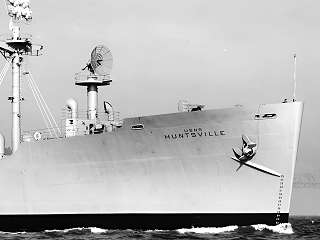
Figure 1: AN/SPQ-8


| Specifications | |
|---|---|
| frequency: | 5 400 … 5 900 MHz
(C band) |
| pulse repetition time (PRT): | |
| pulse repetition frequency (PRF): | |
| pulsewidth (τ): | |
| receiving time: | |
| dead time: | |
| peak power: | |
| average power: | |
| instrumented range: | |
| range resolution: | |
| accuracy: | |
| beamwidth: | |
| hits per scan: | |
| antenna rotation: | |
| MTBCF: | |
| MTTR: | |
AN/SPQ-8
The AN/SPQ-8 was a high-precision target tracking radar operating in the C band (IEEE designation) or G band (NATO designation) in the mid-1960s, used to measure telemetry and flight data. It was used by the US Navy and NASA to track spacecraft during reentry and to support Apollo missions.
Only two such radar sets were built and installed on the ships USNS Watertown (T-AGM 6) and USNS Huntsville (T-AGM 7). The radar sets were later replaced by the more modern AN/FPS-105.