Jindalee
Description of the radar set, tactical-technical characteristics
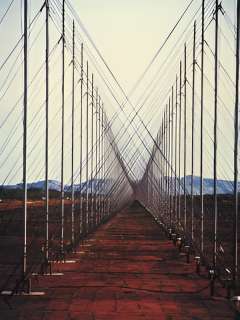
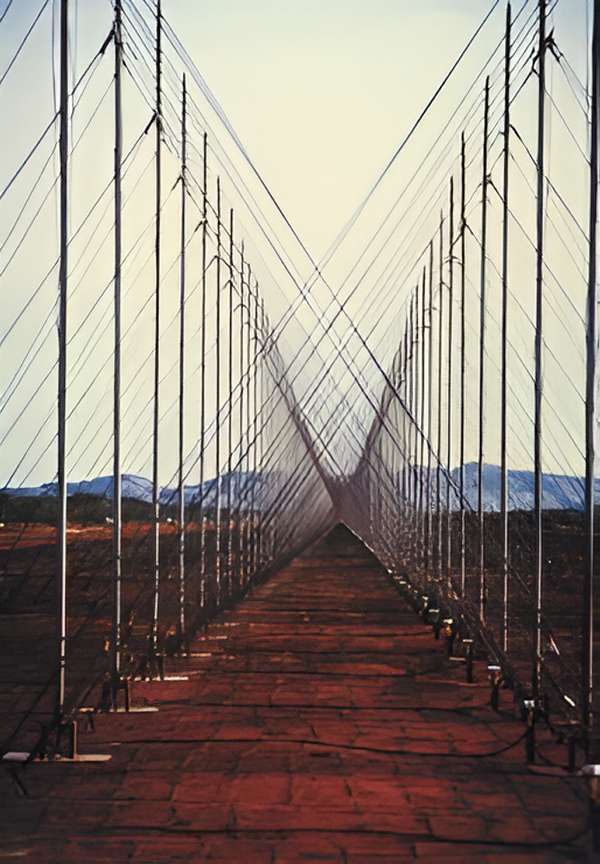
Figure 1: JFAS transmitter site
| Specifications | |
|---|---|
| frequency: | 5 … 28 MHz
(HF band) |
| pulse repetition time (PRT): | |
| pulse repetition frequency (PRF): | |
| pulsewidth (τ): | |
| receiving time: | |
| dead time: | |
| peak power: | 560 kW |
| average power: | |
| instrumented range: | 1 000 … 3 000 km |
| range resolution: | 20 km |
| accuracy: | |
| beamwidth: | 0,5° |
| hits per scan: | |
| antenna rotation: | |
| MTBCF: | |
| MTTR: | |
Jindalee
The Jindalee is an over-the-horizon (backscatter)) radar operating in the HF band (IEEE designation) or in the A band (NATO designation), used by the Royal Australian Air Force.
The radar is a bistatic radar with a phased-array antenna at Harts Range (22°58'3.22“ S 134°26'52.573” E, Alice Springs, Australia), providing 90° coverage. The receiving antenna is located in Mount Everard (23°31'17.389“ S 133°40'39.075” E) and is a linear antenna array approximately 3 km long, with 462 pairs of quarter-wave radiators and 32 receivers arranged in a configuration with one receiver per overlapping subarray. In the current configuration, the receivers are located near the respective antenna array and convert the received signal into a digital format. The initial installation was called Jindalee Facility Alice Springs (JFAS).
The radar was originally built as a research radar and had only low transmission power. It was continuously modified in six phases up to the “Stage B” version (the technical data in the table is from the 1982 version B).
From 1995 onwards, two further radar systems were built in Laverton, Western Australia, and Longreach, Queensland, which became fully operational in 2003. All three radar systems have now been combined to form the Jindalee Operational Radar Network (JORN). Another radar system was sold to Canada.
Source:
- David A Holdsworth, “Jindalee Operational Radar Network: New Growth from Old Roots”, www.researchgate.net