
Reja
Description of the radar set, tactical-technical characteristics
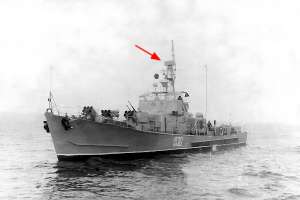
Figure 1: Reja
| Specifications | |
|---|---|
| frequency: | 9.3 … 9.4 GHz
(X band) |
| pulse repetition time (PRT): | |
| pulse repetition frequency (PRF): | 1.6 or 3.2 kHz |
| pulsewidth (τ): | 0.25 or 1 µs |
| receiving time: | |
| dead time: | |
| peak power: | 100 kW |
| average power: | |
| instrumented range: | 20 NM (≙ 37 km) |
| range resolution: | |
| accuracy: | |
| beamwidth: | ≈ 3° |
| hits per scan: | |
| antenna rotation: | |
| MTBCF: | |
| MTTR: | |
Reja
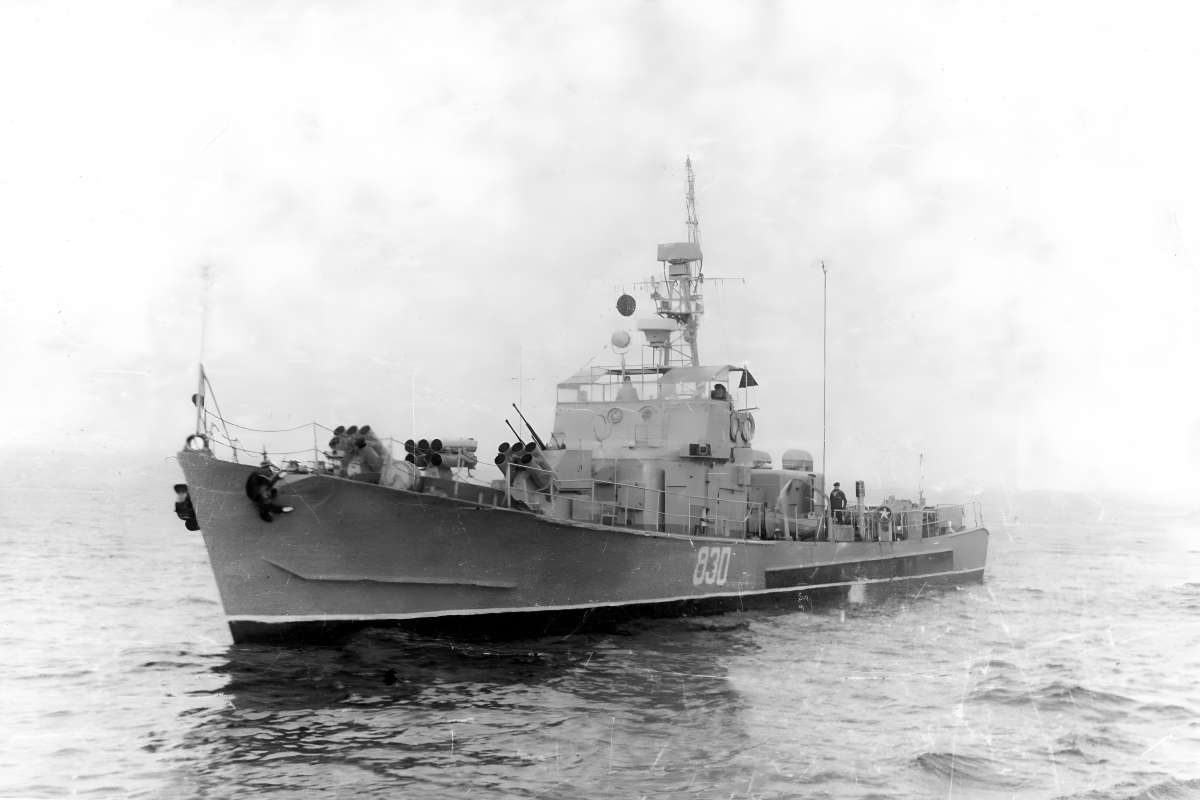
Reja (Cyrillic: «Рея», “yard”, NATO reporting name: “Pot Head”) was a surface search and target tracking radar system operating in the X band (IEEE designation) or in the I band (NATO designation). It was developed in the late 1950s for Soviet torpedo boats to guide torpedoes. It replaced the outdated Zarnitsa. Compared to the MR-102 Baklan, which was developed around the same time, it had a shorter range but was better at detecting submarine snorkels due to its higher resolution and shorter pulse duration.
The antenna width a single curved parabolic reflector was located under a cylindrical radome with a diameter of about 1.2 meters at the top of the mast.