Zarnitsa
Description of the radar set, tactical-technical characteristics
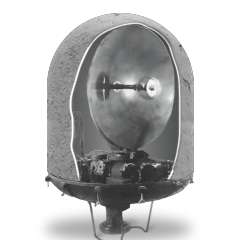
Figure 1: Zarnitsa
| Specifications | |
|---|---|
| frequency: | S band |
| pulse repetition time (PRT): | |
| pulse repetition frequency (PRF): | 400 Hz |
| pulsewidth (τ): | 1 µs |
| receiving time: | |
| dead time: | |
| peak power: | 80 kW |
| average power: | 32 W |
| instrumented range: | 17 NM (≙ 32 km) |
| range resolution: | 160 m |
| accuracy: | |
| beamwidth: | 17° |
| hits per scan: | |
| antenna rotation: | |
| MTBCF: | |
| MTTR: | |
Zarnitsa
Zarnitsa (Cyrillic: «Зарница» Nato-Designator: “Skin Head”) was operating in the S band (IEEE designation) or in the E/F band (NATO designation) lightweight surface search and navigation radar. The radar was developed in 1946 as a replica of the SO radar and was primarily used on torpedo speedboats in the Soviet Pacific Fleet starting in 1948. The production of a clone in China continued until the mid-1960s.
It was protected by a radome with a diameter of 0.8 meters and a height of 1 meter.