
AA NO 3 MK 7
Description of the radar set, tactical-technical characteristics
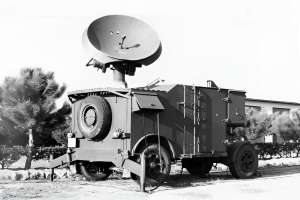
Figure 1: AA NO 3 MK 7



| Specifications | |
|---|---|
| frequency: | 3 000 … 3 120 MHz
(S band) |
| pulse repetition time (PRT): | |
| pulse repetition frequency (PRF): | 1 500 Hz |
| pulsewidth (τ): | 0.55 µs |
| receiving time: | |
| dead time: | |
| peak power: | 200 kW |
| average power: | 75 W |
| instrumented range: | 60 km |
| range resolution: | |
| accuracy: | |
| beamwidth: | |
| hits per scan: | |
| antenna rotation: | |
| MTBCF: | |
| MTTR: | |
AA NO 3 MK 7
AA NO 3 MK 7 was operating in the S band (IEEE designation) or in the F band (NATO designation) fire-control radar for 90mm caliber anti-aircraft guns.
This radar featured a symmetrical parabolic reflector that was fed by a dipole antenna. It had two operational modes: one for target tracking using conical scan with a rotating dipole, and and spiral target search with a fixed dipole.
Developed around 1955, the radar was manufactured under license by the Italian company FIAR, which was a precursor to Contraves. It remained in service until approximately 1968.