
AN/APS-42
Description of the radar set, tactical-technical characteristics
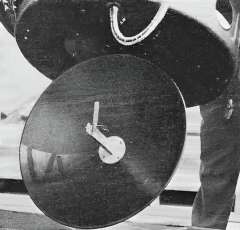
Figure 1: AN/APS-42



| Specifications | |
|---|---|
| frequency: | 9 309 … 9 330 MHz
(X band) |
| pulse repetition time (PRT): | |
| pulse repetition frequency (PRF): | 800, 200, 300 Hz |
| pulsewidth (τ): | 0.75, 3.50, 2.25 or 5.0 µs |
| receiving time: | |
| dead time: | |
| peak power: | 50 kW |
| average power: | |
| instrumented range: | 150 NM (≙ 280 km) |
| range resolution: | |
| accuracy: | |
| beamwidth: | |
| hits per scan: | |
| antenna rotation: | 30 r.p.m. |
| MTBCF: | |
| MTTR: | |
AN/APS-42
AN/APS-42 was operating in the X band (IEEE designation) or in the I band (NATO designation) navigational radar equipment. It provided radar mapping, responder beacon operations, obstacle detection, and weather mapping. The radar is a further deveopment of the AN/APS-10.
The AN/APS-42 radars have been installed on Douglas C-54 Skymaster, Boeing C-97 Stratofreighter, Douglas C-118, Fairchild C-119 Flying Boxcar, Lockheed C-121 Constellation, Douglas C-124 Globemaster II, Lockheed C-130 Hercules, and Convair C-131 Samaritan.
The antenna system consisted of an 18-inch diameter parabolic reflector with a double dipole radiator located at the focal point of the parabola and fed from a waveguide. The antenna was stabilized in roll and pitch.