
Mk. 35
Description of the radar set, tactical-technical characteristics
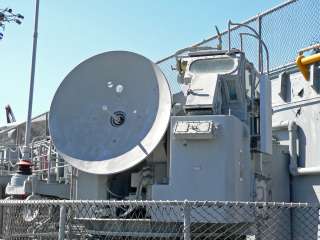
Figure 1: Mk. 35
(Source: Wikipedia, User:Stan Shebs)


| Specifications | |
|---|---|
| frequency: | 8.5 … 9.6 GHz
(X band) |
| pulse repetition time (PRT): | |
| pulse repetition frequency (PRF): | 3 kHz |
| pulsewidth (τ): | 0,1 … 0,15 µs |
| receiving time: | |
| dead time: | |
| peak power: | 50 kW |
| average power: | 275 W |
| instrumented range: | 14 NM (≙ 26 km) |
| range resolution: | |
| accuracy: | 9 m |
| beamwidth: | 2° |
| hits per scan: | |
| antenna rotation: | |
| MTBCF: | |
| MTTR: | |
Mk. 35
Radar equipment Mark 35 is operating in the X band (IEEE designation) or in the I band (NATO designation) fire control radar for use in gun fire Control system Mark 56, which controls heavy machine guns. It supplies error signals to the gun fire Control System in range, bearing and elevation to produce a completely automatic tracking system.
The radar uses spiral scanning for target aquisition and conical scanning for automatic tracking. The parabolic antenna with a diameter of 46 inches provides an antenna gain of 37.5 dBi. It is fed by a nutating Cutler feed. The transmitter uses a forced air cooled mechanically tunable magnetron of type 2J51.
The first radar equipment Mark 35 was delivered in August 1945. This type of radar was later renamed to AN/SPG-35.

