
SCR-718
Description of the radar set, tactical-technical characteristics
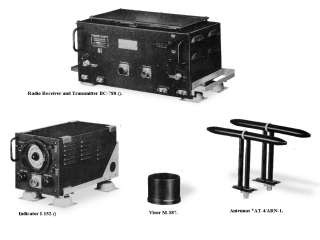
Figure 1: SCR-718

| Specifications | |
|---|---|
| frequency: | 420 … 440 MHz
(UHF band) |
| pulse repetition time (PRT): | |
| pulse repetition frequency (PRF): | |
| pulsewidth (τ): | |
| receiving time: | |
| dead time: | |
| peak power: | |
| average power: | |
| instrumented range: | 50 000 ft |
| range resolution: | |
| accuracy: | |
| beamwidth: | |
| hits per scan: | |
| antenna rotation: | |
| MTBCF: | |
| MTTR: | |
SCR-718
The SCR-718 was an airborne radar altimeter operating in the UHF band (IEEE designation) or B band (NATO designation) based on frequency-modulated continuous wave radar (FMCW radar), which displayed the current altitude above ground to the pilot on a J-scope.
The two dipole antennas were mounted on the wings. 120 measurement cycles per second were performed, during which the transmission frequency scattered directly into the receiving antenna was compared with the frequency of the signal reflected from the ground. The scale of the display could be switched between 50,000 feet and 5,000 feet.
When installed, it weighed 40 lbs and was mechanically and electrically interchangeable with the AN/APN-1 with the exception of the display and AC power connection.