
AN/APN-150
Description of the radar set, tactical-technical characteristics

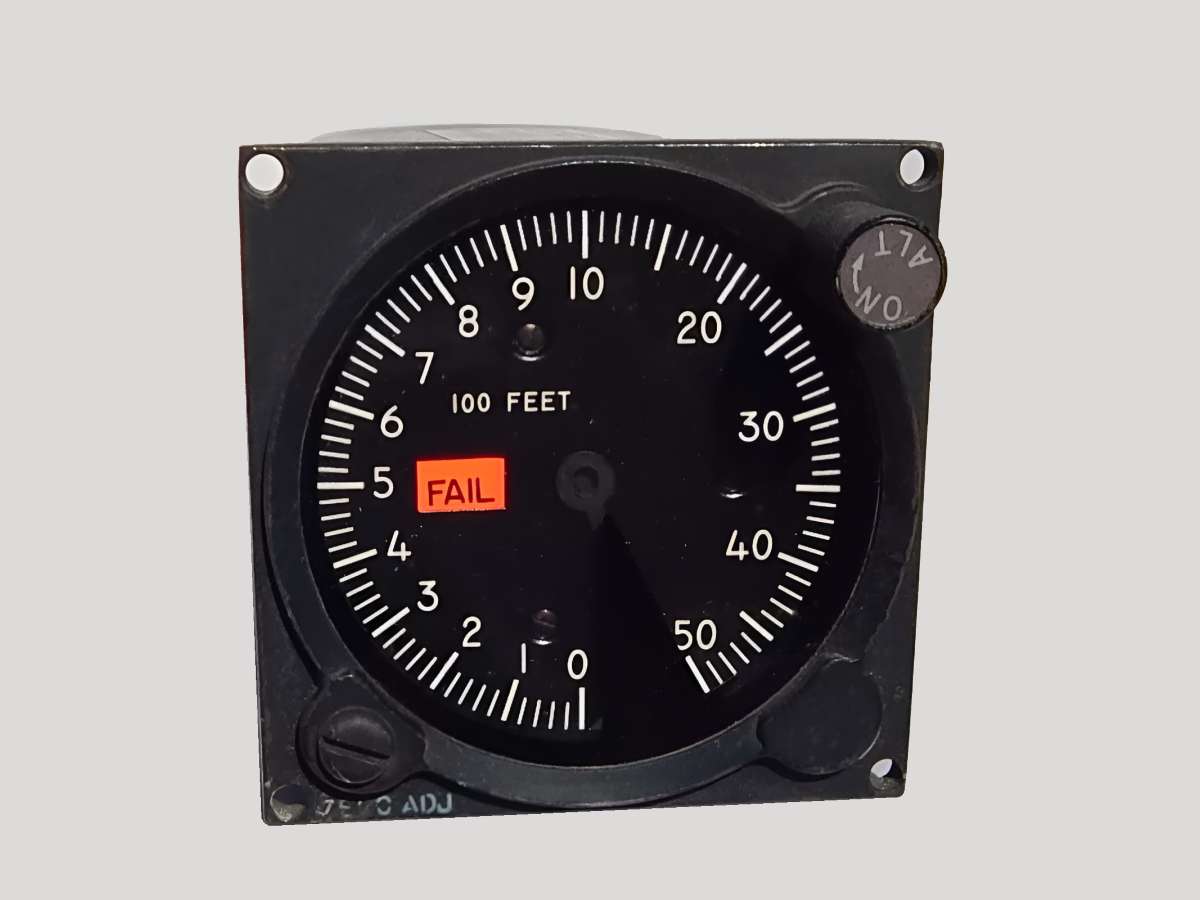
Figure 1: Indicator ID-950/APN-150
Sperry Corporation (1910-1986)
| Specifications | |
|---|---|
| frequency: | 4 330 ±50 MHz
(C band) |
| pulse repetition time (PRT): | |
| pulse repetition frequency (PRF): | |
| pulsewidth (τ): | |
| receiving time: | |
| dead time: | |
| peak power: | |
| average power: | |
| instrumented range: | 5 000 ft (≙ 1,5 km) |
| range resolution: | |
| accuracy: | |
| beamwidth: | |
| hits per scan: | |
| antenna rotation: | |
| MTBCF: | |
| MTTR: | |
AN/APN-150
The AN/APN-150 was an airborne radar altimeter that operated in the C band (IEEE designation) or in the G band (NATO designation) according to the FMCW principle. It gives a continuous readout on an instrument showing exact altitude from 0 to 5,000 feet and was designed for low-level flying and landing of aircraft. It was developed as a replacement for the AN/APN-22. The AN/APN-150 was used in the Boeing B-52H “Stratofortress”, Sikorsky CH-3C “Sea King”, “Lockheed C-130 Hercules”, and Boeing C-135 “Stratolifter”. Later, it was replaced by the AN/APN-194.
Source:
- Military Standardization Handbook, United States Radar Equipment Manual TM 11-487C-1 1965, p. 800f