
AN/APN-194
Description of the radar set, tactical-technical characteristics
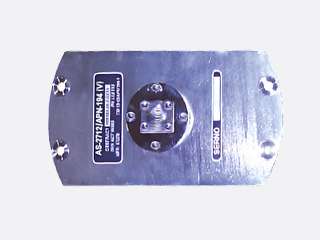
Figure 1: AN/APN-194


| Specifications | |
|---|---|
| frequency: | 4 300 MHz
(C band) |
| pulse repetition time (PRT): | |
| pulse repetition frequency (PRF): | |
| pulsewidth (τ): | 0.02 or 0.2 µs |
| receiving time: | |
| dead time: | |
| peak power: | |
| average power: | |
| instrumented range: | 5 000 ft |
| range resolution: | |
| accuracy: | ± 3 ft or 4% |
| beamwidth: | |
| hits per scan: | |
| antenna rotation: | |
| MTBCF: | 2 500 hr |
| MTTR: | |
AN/APN-194
AN/APN-194 is operating in the C band (IEEE designation) or in the G band (NATO designation), a widely used Low Probability of Intercept Altimeter (LPIA) that meets all requirements of MILA-81605(AS). It is a pulsed, range-tracking radar that measures the surface of terrain clearance below the aircraft.
The system includes a receiver-transmitter (RT-l0l5 and RT-l042), two antennas (AS-2712), and one or more height indicators.
AN/APN-194 was first introduced in 1971 and was used, e.g., in the Grumman F-14 Tomcat. The radar was modified to all solid state in 1979 and got the designator AN/APN-194(V).