
Dunay-2
Description of the radar set, tactical-technical characteristics
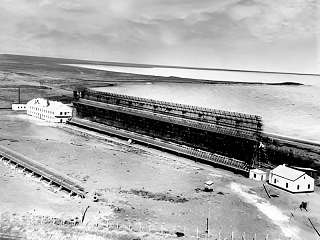
Figure 1: Dunay-2, receiver site
(45°56’50.0" N 73°37’52.0" E)
 Нижегородский

| Specifications | |
|---|---|
| frequency: | VHF band |
| pulse repetition time (PRT): | |
| pulse repetition frequency (PRF): | |
| pulsewidth (τ): | |
| receiving time: | |
| dead time: | |
| peak power: | |
| average power: | 80 kW |
| instrumented range: | 650 NM (≙ 1 200 km) |
| range resolution: | |
| accuracy: | |
| beamwidth: | 0,6° … 16° |
| hits per scan: | |
| antenna rotation: | |
| MTBCF: | |
| MTTR: | |
Dunay-2
Dunay-2 (Cyrillic: Дунай-2, “Danube-2”, NATO code name: “Hen Roost”) was operating in the VHF band (IEEE designation) or in the A band (NATO designation) continuous wave (CW) radar for early warning of ballistic missiles that measured the distance and two angular coordinates of the target. The Dunay-2 was a prototype built in Sary Shagan on the shore of Lake Baikal as part of the experimental missile defence system “A”.
The transmitter and receiver positions of the station with its antenna systems were located one kilometer apart in the terrain. The transmitting equipment consisted of two transmitters, each with an output of 40 kW. The transmitting antenna system was designed as a single curved parabolic reflector fed by two slotted waveguides. The dimensions of the transmitting antenna system were 8 by 150 m. The transmitting antenna formed two directional characteristics in space with a size of 0.6 degrees to 16 degrees (depending on the steering angle). The electronic steering direction was dependent on the transmission frequency. The receiving antenna system consisted of two antenna arrays similar to the transmitting antenna system and two pairs of slotted waveguides. An elevation angle could be achieved by phase comparison between the two antenna planes. The overall dimensions of the receiving antenna system were 20 by 150 m.