
AN/APN-113
Description of the radar set, tactical-technical characteristics
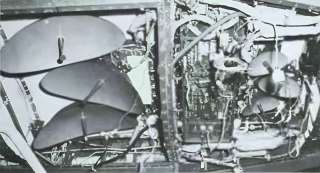
Figure 1: AN/APN-113, the three receiving antennas on the left, the transmitting antennas in the background on the right

Figure 1: AN/APN-113, the three receiving antennas on the left, the transmitting antennas in the background on the right

| Specifications | |
|---|---|
| frequency: | Ku band |
| pulse repetition time (PRT): | |
| pulse repetition frequency (PRF): | |
| pulsewidth (τ): | |
| receiving time: | |
| dead time: | |
| peak power: | |
| average power: | |
| instrumented range: | 20 km |
| range resolution: | |
| accuracy: | |
| beamwidth: | |
| hits per scan: | |
| antenna rotation: | |
| MTBCF: | |
| MTTR: | |
AN/APN-113
The AN/APN-113 was a Doppler radar operating in the Ku band (IEEE designation) or in the J band (NATO designation) It was used as part of the AN/ASQ-42 navigation and bomb release system in the Convair B-58. The Doppler unit was mounted under two plexiglas plates in the tail section of the fuselage near the wing’s trailing edge. The system included three separate continuous wave radars with individual transmit and receive antennas, which provided data for accurate calculation of the aircraft’s speed. One radar was aimed diagonally forward to measure ground speed. The other two radars pointed at right angles to the left and right to measure drift caused by wind across the flight path. The AN/APN-133, also part of the AN/ASQ-42 system, was used to measure altitude.
The radar system was originally developed by Sperry in the early 1960s, but after Raytheon acquired this division of Sperry, it was marketed under Raytheon’s label.