
AN/APN-133
Description of the radar set, tactical-technical characteristics
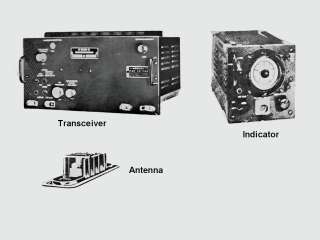
Figure 1: AN/APN-133


US-American
| Specifications | |
|---|---|
| frequency: | 1 635 … 1 645 MHz
(L band) |
| pulse repetition time (PRT): | |
| pulse repetition frequency (PRF): | |
| pulsewidth (τ): | 49 164 or 9 830 Hz |
| receiving time: | 0,124 or 0,144 µs |
| dead time: | |
| peak power: | 125 W |
| average power: | |
| instrumented range: | 75 000 ft (≙ 23 km) |
| range resolution: | |
| accuracy: | |
| beamwidth: | 55° |
| hits per scan: | |
| antenna rotation: | |
| MTBCF: | |
| MTTR: | |
AN/APN-133
AN/APN-133 is operating in the L band (IEEE designation) or in the D band (NATO designation) high altitude radar altimeter for airborne use. It is a modified SCR-728 and used in C-130 and C-135.
The colinear antenna array consists of two dipole antennas in one housing, providing an antenna gain of 8 dBi. They are fed by a coaxial cable of 50 ohms characteristic impedance. Each dipole is approximately 13 inches long, 4 inches wide, and 2-3/4 inches high.
The AN/APN-133A had an improved receiver, slightly reduced transmission power, and, therefore, less interfering side lobes in the frequency spectrum. The pulse duration for long-range operation was increased to 0.5 µs to keep the transmitted energy for the maximum range.
Source:
- Military Standardization Handbook, United States Radar Equipment Manual TM 11-487C-1 1965, p. 787f