
WF-1
Description of the radar set, tactical-technical characteristics
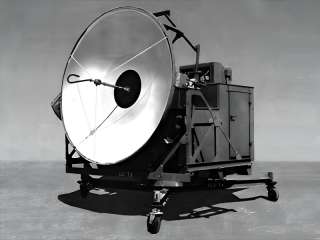
Figure 1: WF-1


| Specifications | |
|---|---|
| frequency: | X band |
| pulse repetition time (PRT): | |
| pulse repetition frequency (PRF): | |
| pulsewidth (τ): | |
| receiving time: | |
| dead time: | |
| peak power: | 25 kW |
| average power: | |
| instrumented range: | |
| range resolution: | |
| accuracy: | |
| beamwidth: | |
| hits per scan: | |
| antenna rotation: | |
| MTBCF: | |
| MTTR: | |
WF-1
WF-1 was a target tracking radar operating in the X band (IEEE designation) or in the I/J band (NATO designation) used to track passive weather balloons to measure wind speeds at high altitudes.
The parabolic antenna had an 8-foot (approximately 2.4 m) diameter and used a conical scan. The antenna was still steered manually by the operator sitting in the cabin.
The WF-1 was produced in 1956 and was one of the first civilian radar sets.