
SGR 108/03
Description of the radar set, tactical-technical characteristics
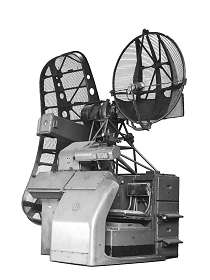
Figure 1: SGR 108/03

| Specifications | |
|---|---|
| frequency: | X band |
| pulse repetition time (PRT): | |
| pulse repetition frequency (PRF): | |
| pulsewidth (τ): | |
| receiving time: | |
| dead time: | |
| peak power: | 50 kW |
| average power: | |
| instrumented range: | 25 km |
| range resolution: | |
| accuracy: | |
| beamwidth: | |
| hits per scan: | |
| antenna rotation: | |
| MTBCF: | |
| MTTR: | |
SGR 108/03
SGR 108/03 (other designations: L4/3 and KL/MSS-301) was operating in the X band (IEEE designation) or in the I band (NATO designation) fire-control radar for light anti-aircraft guns.
The round parabolic antenna with a diameter of 1 m is part of the target tracking radar. The vertical paraboloid served as a search radar and had dimensions of 0.7 × 2.2 m.
The radar was developed in the early 1950s by Philips Telecommunicatie Industrie, N.V. This division of Philips AG was later outsourced to Hollandse Signaalapparaten BV. The radar was in service until the mid-1960s.


