
Irtysh SKU
Description of the radar set, tactical-technical characteristics
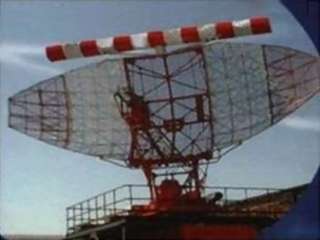
Figure 1: Irtysh SKU
Figure 1: Irtysh SKU
 Manufacturer:
«Granit-Electron»
| Specifications | |
|---|---|
| frequency: | L band |
| pulse repetition time (PRT): | |
| pulse repetition frequency (PRF): | |
| pulsewidth (τ): | |
| receiving time: | |
| dead time: | |
| peak power: | 200 kW |
| average power: | |
| instrumented range: | 180 km |
| range resolution: | |
| accuracy: | |
| beamwidth: | 2° |
| hits per scan: | |
| antenna rotation: | |
| MTBCF: | |
| MTTR: | |
Irtysh SKU
The Irtysh SKU (Cyrillic: «Иртыш-СКУ») was a pseudo-coherent surveillance radar operating in L band (IEEE designation) or D band (NATO designation) for use at airfields.
The antenna was a modified parabolic reflector that generated a cosecant squared pattern. It was fed by two horizontally polarized horn radiators, which were connected to the magnetron transmitter with coaxial cables. The radar already used a digital system for fixed clutter suppression.
The radar was put into service around 1990 and replaced in 1997 by a more modern radar in S band (IEEE designation) or E band (NATO designation).