
WRS400
Description of the radar set, tactical-technical characteristics
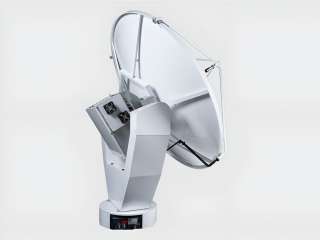
Figure 1: WRS400

| Specifications | |
|---|---|
| frequency: | 9 300 … 9 700 MHz
(X band) |
| pulse repetition time (PRT): | |
| pulse repetition frequency (PRF): | max. 3 kHz |
| pulsewidth (τ): | 0.5 … 90 or 100 µs |
| receiving time: | |
| dead time: | |
| peak power: | 2 × 400 W or 2 × 200 W |
| average power: | |
| instrumented range: | 50 … 100 … 150 km |
| range resolution: | |
| accuracy: | |
| beamwidth: | < 1,8° or < 0,95° |
| hits per scan: | |
| antenna rotation: | |
| MTBCF: | |
| MTTR: | |
WRS400
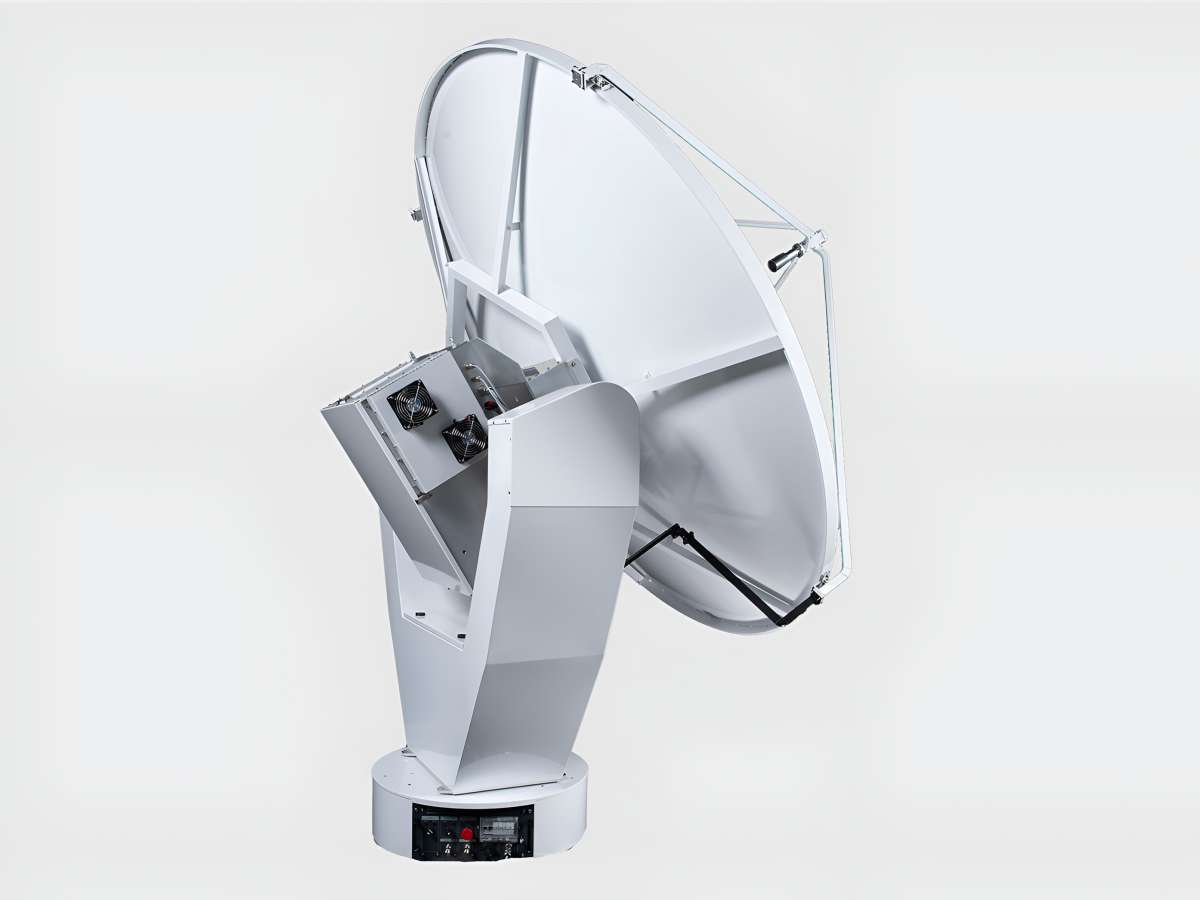
The WRS400 is a compact, X-band (IEEE designation), or I-band (NATO designation), fully coherent dual-polarization weather radar. It was developed specifically for high-resolution monitoring at short to medium ranges, particularly to fill gaps (as a gap-filler) in existing radar networks (e.g., in mountain valleys, close to the ground, or near wind farms), as well as for use at airports and ports.
The entire outdoor unit weighs only about 340 to 385 kg and can be installed on building rooftops or mobile platforms. The transmitters are actively air-cooled, so the radar should be installed under a radome to protect it from the weather. As with the larger sister model, WRS300, the two independent solid-state transmitter modules based on gallium nitride semiconductor power amplifiers, together with the digital receivers for horizontal (H) and vertical (V) polarization, are mounted directly behind the reflector on the antenna turntable. The radar uses an antenna with a symmetrical parabolic reflector, available with either a diameter of 1.4 m (requiring a 2.4 m radome) for particularly compact installations or a diameter of 2.4 m (requiring a 3.7 m radome) for improved angular resolution.
Sources:
- Data sheet provided by the manufacturer
- Website of the manufacturer