
WRS300
Description of the radar set, tactical-technical characteristics
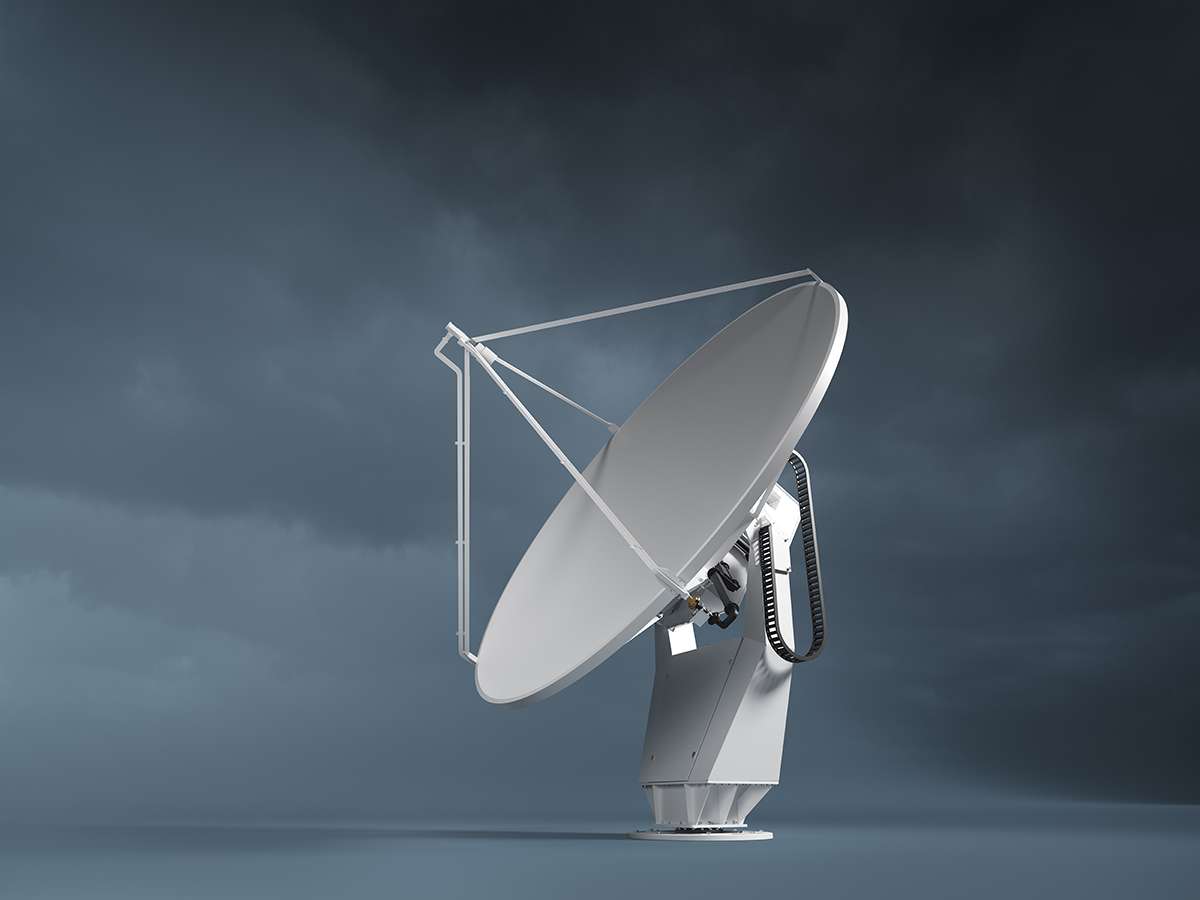
Figure 1: WRS300

| Specifications | |
|---|---|
| frequency: | 5,5 … 5,7 GHz
(C band) |
| pulse repetition time (PRT): | |
| pulse repetition frequency (PRF): | max. 2,5 kHz |
| pulsewidth (τ): | 0,5 … 200 µs |
| receiving time: | |
| dead time: | |
| peak power: | 2 × 4 kW or 2 × 2 kW |
| average power: | |
| instrumented range: | max.: 500 km |
| range resolution: | |
| accuracy: | |
| beamwidth: | < 1° |
| hits per scan: | |
| antenna rotation: | |
| MTBCF: | |
| MTTR: | |
WRS300
The WRS300 is a fully coherent C-band (IEEE designation), or G-band (NATO designation), polarimetric weather radar based on modern gallium nitride solid-state power amplifiers (SSPA). It was developed for large-area meteorological surveillance and for air traffic control, including wind shear detection in the vicinity of airports.
The radar uses a symmetrical parabolic reflector antenna with a diameter of 4.5 m and an antenna gain of 45 dBi. The complete transmitter and receiver units (transceivers) for horizontal (H) and vertical (V) polarization are separate, designed with redundancy, and integrated directly into the rotating pedestal. This eliminates lossy waveguide rotary joints and bulky transmitter cabinets in the radar tower.
Because of the solid-state transmitter design, intrapulse modulation must be used. To overcome the blind zone at short ranges caused by the longer transmitted pulses, the radar combines a long frequency-modulated pulse (chirp / pulse compression) for long-range measurements with a short, unmodulated pulse transmitted immediately afterward for short-range coverage. The two pulses are separated in frequency and seamlessly blended in the signal processor, avoiding abrupt changes in sensitivity.
Sources:
- Manufacturer's data sheet
- Manufacturer's press release
- Description of the hybrid pulsing system for weather radar