
Luneburg Lens

Figure 1: The Luneburg lens can simultaneously serve multiple receiving channels and directions.

Luneburg Lens
A Luneburg lens is an antenna that uses a spherical lens with a gradient refractive index to efficiently direct radio waves.
The Luneburg lens is made of a dielectric material that has a dielectric constant which continuously increases from the surface to twice its value at the center of the sphere, following a specific mathematical profile known as the Luneburg profile:
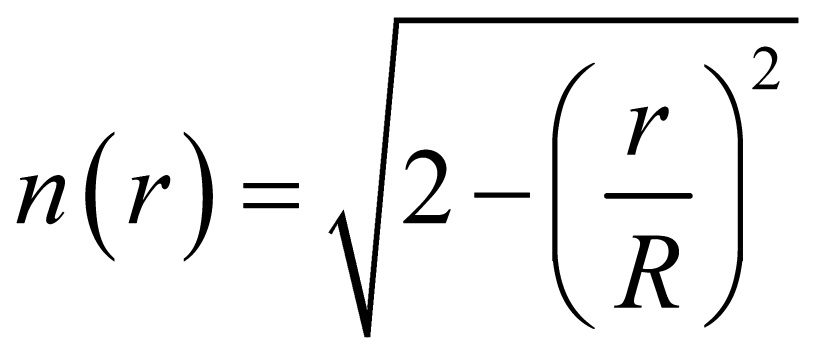
(1)
- n = refractive index
- R = radius of the sphere
Here, too, the electromagnetic waves are always bent towards the denser medium. This inhomogeneous spherical lens is capable of perfectly focusing a collimated beam onto its rear surface. It can accommodate a parallel beam that fills the entire aperture without experiencing spherical aberrations. Furthermore, the focusing properties of the Lüneburg lens remain consistent regardless of frequency and polarization.
Lüneburg lens antennas were commonly used in radar systems for both military and civilian applications. They played a crucial role in transmitting and receiving radar signals, enabling the accurate detection and tracking of objects. However, it is difficult to create a uniform gradient with sufficient accuracy, which is why stepwise compaction is often used. With the advent of phased array antennas, the significance of Lüneburg lens antennas has diminished. Today, they are primarily used as retro-reflectors at best.
Rudolf Karl Lüneburg developed the theory for this spherically symmetric lens in 1944[1] as an academic exercise in classical optics.
Sources and ressources:
- R. K. Luneburg, “The Mathematical Theory of Optics”, Brown University Providence, Rhode Island, 1944, 208-213.