
Anti-UAV radar

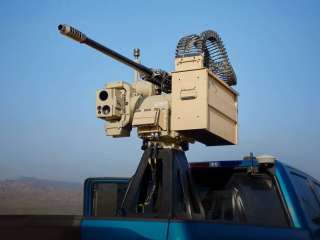
Bild 1: Maschinengewehr mit dem Drohnenerkennungsradar EchoGuard
Anti-UAV radar
An anti-UAV radar or drone detection radar has to meet special requirements. While relatively large, mostly military unmanned aerial vehicles (UAVs, “drones”) can be detected like normal aircraft, very small drones such as mini-UAVs or nano-UAVs have the special feature that their radar cross section (RCS) is very small at < 0.01 m², which means that the radar must be particularly sensitive. This RCS is comparable to that of a small bird. Because non-conductive materials are usually used in their construction, this RCS can be even smaller, at up to < 0.001 m², which is comparable to a larger insect.
Both the pulse radar method and the cheaper FMCW method can be used to construct an anti-UAV radar. Both versions must use a high carrier frequency whose wavelength is significantly smaller than the object to be detected.
FMCW-Radar
Drone detection radars based on the FMCW method have energy advantages and also require a much lower bandwidth of the transmitted signal. However, the disadvantage is that the measurement method often cannot distinguish whether the frequency change in the received signal is due to the shift between the received frequency and the transmitted frequency because of the runtime of the echo signal, or whether it is due to a Doppler frequency. For this reason, the detection of extremely fast flying drones is often not possible or at least inaccurate in terms of distance measurement.
A simple FMCW radar can therefore usually only be used against smaller, relatively slow-flying mini-UAVs or nano-UAVs that move at a maximum radial speed of 40 to 100 km/h. However, there are also ways of distinguishing between Doppler and runtime with FMCW radar. This makes radar signal processing much more complicated and requires more extensive software with relatively long computing times. This, in turn, reduces the data refresh rate, so that only a few measurement results per second can be expected.
Impulsradar
Larger, very fast flying (> 150 km/h) military attack drones (including cruise missiles) can only be detected with pulse radar. These are usually expensive short-range multifunction radars that are linked to a defense system (ground-to-air missiles, automatic guns).