
Analog Voltmeters and Ammeters
Electric current cannot be perceived directly by the human senses. However, by deliberately observing its effects, reliable conclusions can be drawn about its presence and magnitude. Measuring instruments for electrical voltage therefore always convert electrical energy into another form of energy (usually mechanical motion), which can then be observed directly.
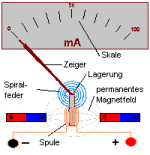
Figure 1: Moving-coil instrument
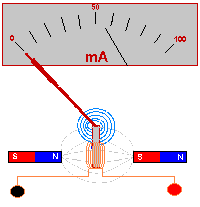
Figure 1: Moving-coil instrument
magnetic effect
Most analog pointer instruments use this effect. The commonly used term “moving-coil instrument” already describes its operating principle.
A coil mounted so that it can rotate in a permanent magnetic field is held in a defined position by a spiral spring. When the current to be measured flows through this coil, the induced magnetic field acts against the permanent magnetic field, and the resulting force moves the pointer against the force of the spiral spring.
Since very small currents must also be measured and the induced magnetic field is therefore very weak, high demands are placed on the mechanical construction (low friction, low inertia…).
The moving-coil measuring instrument is suitable only for direct voltage and direct current, because even an alternating current with a frequency of only a few hertz causes, at best, a slight trembling of the sluggish pointer. To measure alternating current, a suitable rectifier must be connected ahead of the instrument, so that a pulsating direct current is produced. The resistance of a coil varies with frequency. This means that the scale for alternating current must be calibrated separately, and even then it is valid only for relatively low frequencies (up to a maximum of 1 kHz).
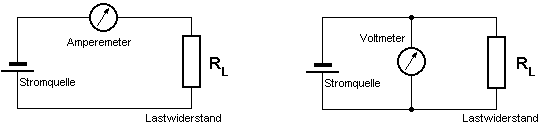

Figure 2: Use as an ammeter and as a voltmeter
In practical construction, several compromises must be made, because some requirements for the instrument contradict one another, for example:
- An ammeter, because it is connected in series with the load resistance, should have the smallest possible internal resistance, so that it does not distort the measurement result.
- A voltmeter, because it is connected in parallel with the load resistance, should have the largest possible internal resistance, so that it does not distort the measurement result.
This internal resistance also makes it possible for an instrument of the same basic construction to be used both for current measurement and for voltage measurement. A range selector switch usually connects a number of measuring resistors either in parallel or in series with the actual measuring mechanism.
The moving-coil measuring instrument can measure only the RMS value of an alternating voltage. The waveform of the alternating voltage, for example a sinusoidal voltage, must therefore be known in order to calculate the peak voltage from the RMS value.
Hot-wire measuring instrument
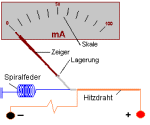
Figure 3: Hot-wire measuring instrument
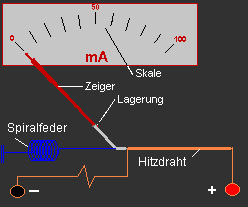
Figure 3: Hot-wire measuring instrument
The principle is similar in a hot-wire measuring instrument, but the heated wire is unaffected by whether direct current or high-frequency alternating current heats it: it expands, becomes longer, and the spiral spring moves the pointer to another position on the scale.
However, because of the high accuracy often required today, measuring instruments operating according to this principle have become genuine rarities. More complex measuring instruments based on semiconductor technology are generally used instead, and with the same frequency tolerance they are several orders of magnitude more accurate.