
AN/APX-6
Description of the radar set, tactical-technical characteristics
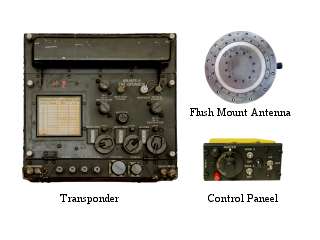
Figure 1: AN/APX-6


| Specifications | |
|---|---|
| frequency: | 950 … 1 150 MHz
(L band) |
| pulse repetition time (PRT): | |
| pulse repetition frequency (PRF): | |
| pulsewidth (τ): | |
| receiving time: | |
| dead time: | |
| peak power: | 1 kW |
| average power: | |
| instrumented range: | 150 NM (≙ 278 km) |
| range resolution: | |
| accuracy: | |
| beamwidth: | |
| hits per scan: | |
| antenna rotation: | |
| MTBCF: | |
| MTTR: | |
AN/APX-6
The AN/APX-6 was an IFF Transponder operating in the L band (IEEE designation) or D band (NATO designation). The transponder used the Mark Ⅴ standard on a new frequency band, also known as the United Nations Beacon or UNB. It could receive double pulses between 960 and 1150 MHz, and replied with single or double pulses, depending on the setting of the cockpit control panel. It was therefore also able to operate the frequencies of the new Mark Ⅹ standard.
The APX-6 was introduced around 1947 and briefly became the standard transponder used in many aircraft, such as the Boeing B-52 Stratofortress and the Lockheed C-130 Hercules.
Source:
- Military Standardization Handbook United States Radar Equipment Manual TM 11-487C-1 1965, p. 916ff