
AN/APX-90
Description of the radar set, tactical-technical characteristics
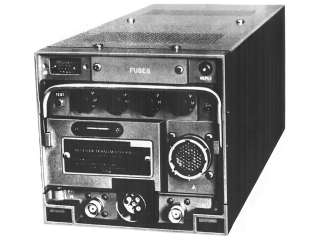
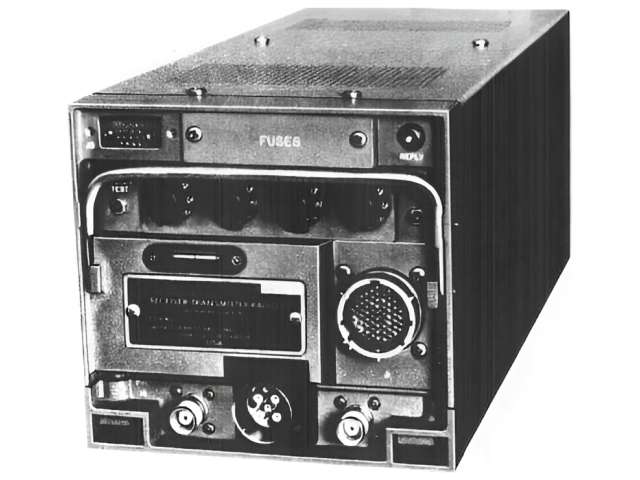
Figure 1: AN/APX-90 Transponder

| Specifications | |
|---|---|
| frequency: | 1 030 and 1 090 MHz
(L band) |
| pulse repetition time (PRT): | |
| pulse repetition frequency (PRF): | |
| pulsewidth (τ): | |
| receiving time: | |
| dead time: | |
| peak power: | 800 W |
| average power: | |
| instrumented range: | |
| range resolution: | |
| accuracy: | |
| beamwidth: | |
| hits per scan: | |
| antenna rotation: | |
| MTBCF: | |
| MTTR: | |
AN/APX-90
AN/APX-90 wa operating in the L band (IEEE designation) or in the D band (NATO designation) airborne transponder with the ICAO-Standard Mark Ⅹ. It was one of the first transponders using the antenna diversity (so called Hartlobe system).
The power supply required a DC voltage of 17 to 30 volts with a power consumption of approximately 80 watts.
The transponder hit the market around 1967.