
AN/APQ-69
Description of the radar set, tactical-technical characteristics
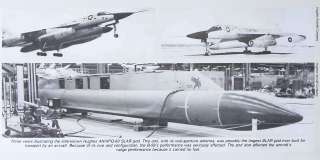
Figure 1: AN/APQ-69

| Specifications | |
|---|---|
| frequency: | X band |
| pulse repetition time (PRT): | |
| pulse repetition frequency (PRF): | |
| pulsewidth (τ): | |
| receiving time: | |
| dead time: | |
| peak power: | |
| average power: | |
| instrumented range: | 50 NM (≙ 93 km) |
| range resolution: | 10 ft |
| accuracy: | |
| beamwidth: | |
| hits per scan: | |
| antenna rotation: | |
| MTBCF: | |
| MTTR: | |
AN/APQ-69
The AN/APQ-69 was an experimental SLAR operating in the X band (IEEE designation) or in the I band (NATO designation), housed in an external pod approximately 50 feet (≙ 15 m) long. The radar was developed specifically for the Convair B-58 Hustler supersonic bomber, but it reduced the aircraft’s range and limited its speed to the subsonic range.
The AN/APQ-69 was built in the late 1950s and led to the development of the AN/APS-73 synthetic aperture radar.