
AN/APS-73
Description of the radar set, tactical-technical characteristics
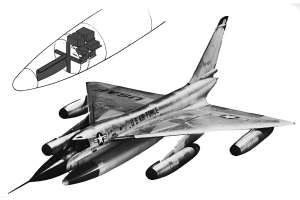
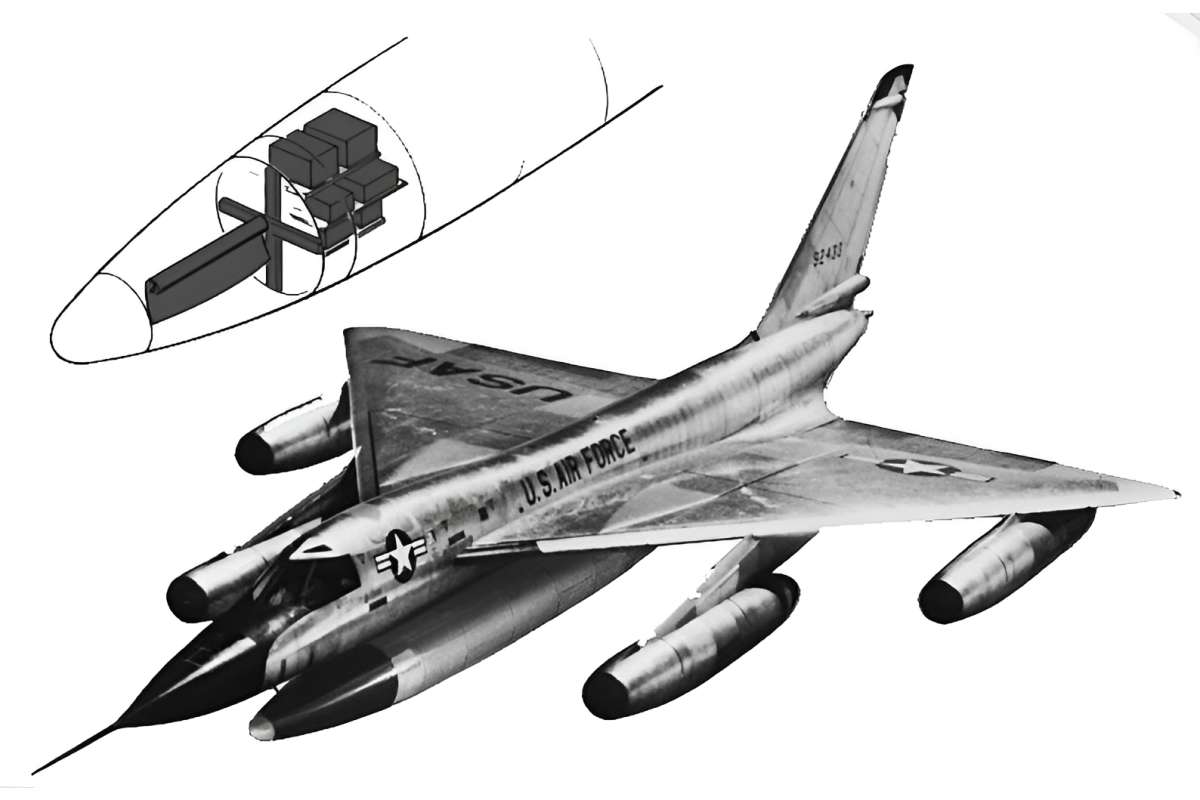
Figure 1: AN/APS-73

| Specifications | |
|---|---|
| frequency: | X band |
| pulse repetition time (PRT): | |
| pulse repetition frequency (PRF): | |
| pulsewidth (τ): | |
| receiving time: | |
| dead time: | |
| peak power: | |
| average power: | |
| instrumented range: | 80 NM (≙ 148 km) |
| range resolution: | 50 ft |
| accuracy: | |
| beamwidth: | |
| hits per scan: | |
| antenna rotation: | |
| MTBCF: | |
| MTTR: | |
AN/APS-73
The AN/APS-73 was Synthetic Aperture Radar (SAR) operating in the X band (IEEE designation) or in the I band (NATO designation).
The radar used two antennas that transmitted to the left and right of the aircraft’s course. It was housed in a modified external pod, but occupied less than a third of the space, allowing the remaining space to be used as an auxiliary fuel tank. The APS-73 was intended to be the successor to the AN/APQ-69 for the Convair B-58 Hustler supersonic bomber. However, only the prototype was installed in a B-58 because the signal processing required a specific ratio between airspeed and pulse repetition frequency, and the B-58 could therefore continue to fly in the subsonic range only. Further modifications, from the APS-73(XH-1) to the APS-73(XH-4), were tested in other aircraft, such as the B-29 and the C-97.