
AN/UPS-1
Description of the radar set, tactical-technical characteristics
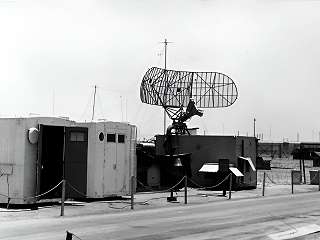
Figure 1: AN/UPS-1 at Muharraq in 1971


| Specifications | |
|---|---|
| frequency: | 1 250 … 1 350 MHz
(L band) |
| pulse repetition time (PRT): | |
| pulse repetition frequency (PRF): | 800 or 267 Hz |
| pulsewidth (τ): | 1.4 or 4.2 µs |
| receiving time: | |
| dead time: | |
| peak power: | 1.4 MW |
| average power: | 1.6 kW |
| instrumented range: | 275 NM (≙ 275 km) |
| range resolution: | 900 m |
| accuracy: | |
| beamwidth: | 3.8° |
| hits per scan: | |
| antenna rotation: | 15 min⁻¹ |
| MTBCF: | |
| MTTR: | |
AN/UPS-1
The AN/UPS-1 was a lightweight surveillance radar used by the US Navy that operated in the L band (IEEE designation) or in the D band (NATO designation) and could be transported by a Sikorsky S-58 helicopter.
The radar underwent several modifications, ranging from UPS-1A to UPS-1F. It featured moving target indication, which, however, required a fixed pulse repetition frequency due to the design of the delay line. Despite the enormous range scale on the PPI scope, the radar achieved an energetic maximum range of approximately 100 NM (≙ 185 km).