
AN/TPQ-31
Description of the radar set, tactical-technical characteristics
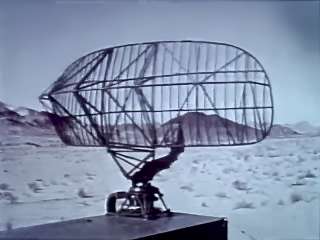
Figure 1: AN/TPQ-31


| Specifications | |
|---|---|
| frequency: | 1 250 … 1 350 MHz
(L band) |
| pulse repetition time (PRT): | |
| pulse repetition frequency (PRF): | 1 600 or 267 Hz |
| pulsewidth (τ): | 0.7 or 4.2 µs |
| receiving time: | |
| dead time: | |
| peak power: | 1 MW |
| average power: | 1 kW |
| instrumented range: | 200 mi (≙ 370 km) |
| range resolution: | |
| accuracy: | |
| beamwidth: | 3.7° |
| hits per scan: | |
| antenna rotation: | 30 min⁻¹ |
| MTBCF: | |
| MTTR: | |
AN/TPQ-31
The AN/TPQ-31 was a counter-mortar radar operating in the L band (IEEE designation) or D band (NATO designation), which was developed from an AN/UPS-1 around 1967. The system's function was to detect incoming mortar and artillery rounds out to 20 km. The high pulse repetition frequency was mainly adapted for this task.
The antenna produced a cosecant squared pattern with a vertical aperture of 11° and an antenna gain of 27.5 dBi. The display was on a PPI scope with an initial diameter of 10 inches, later 16 inches. The scale was selectable between 10, 20, and 275 statute miles. A more accurate distance measurement was possible with an A scope, which used a cathode-ray tube with a diameter of 3 inches.
Source:
- Raytheon: AN/TPQ-31 Performance - During Evaluation as a Hostile Weapon Locator AD 778 192