
AN/APN-153
Description of the radar set, tactical-technical characteristics
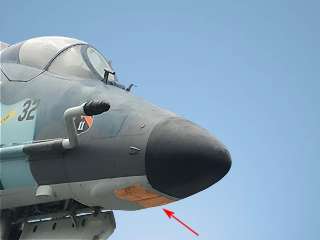
Figure 1: The Indonesian McDonnell Douglas A-4 Skyhawk with the AN/APN-153


| Specifications | |
|---|---|
| frequency: | Ku band |
| pulse repetition time (PRT): | |
| pulse repetition frequency (PRF): | |
| pulsewidth (τ): | |
| receiving time: | |
| dead time: | |
| peak power: | |
| average power: | |
| instrumented range: | |
| range resolution: | |
| accuracy: | |
| beamwidth: | |
| hits per scan: | |
| antenna rotation: | |
| MTBCF: | |
| MTTR: | |
AN/APN-153
AN/APN-153 is operating in the Ku band (IEEE designation) or in the J band (NATO designation) Doppler navigation radar. Its roll-stabilized antenna assembly emits four beams in different directions and measures the ground speed and the drift angle and calculates the along and cross heading velocity. The radar uses a magnetron power oscillator whose PRF is varied by a sawtooth voltage.
The RF from the transmitter is fed to the Antenna where two radiation patterns are emitted alternately at half-second intervals. Each pattern consists of two lobes; one transmitted to the right-front and left-rear, the other to the left-front and right-rear of the aireraft. The RF energy in these lobes strikes the ground at the corners of a rectangle. Thus, the echo returned from the ground always contains the reflection of both a front- and a rear-pointing lobe, the frequency of each being Doppler-shifted as a result of the aircraft motion.
AN/APN-153 was used in the Indonesian McDonnell Douglas A-4 Skyhawk and replaced the earlier AN/APN-122.
Note: The use of a pulsed magnetron enabled a simple duplexer and reduced the number of antennas compared to a continuous wave radar. Unfortunately, this created the problem of blind speeds, which was then solved by the variable pulse repetition frequency.