
Grifo-7
Description of the radar set, tactical-technical characteristics
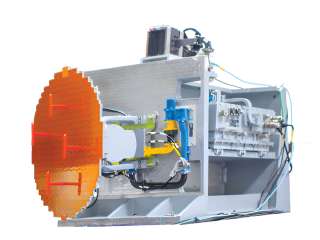
Figure 1: Grifo-7

| Specifications | |
|---|---|
| frequency: | X band |
| pulse repetition time (PRT): | |
| pulse repetition frequency (PRF): | |
| pulsewidth (τ): | |
| receiving time: | |
| dead time: | |
| peak power: | 100 kW |
| average power: | 540 W |
| instrumented range: | 60 NM (≙ 110 km) |
| range resolution: | |
| accuracy: | |
| beamwidth: | |
| hits per scan: | |
| antenna rotation: | |
| MTBCF: | |
| MTTR: | |
Grifo-7
Grifo-7 was a member of the Grifo-Familiy of operating in the X band (IEEE designation) or in the I band (NATO designation) airborne fire-control radars. The radar was installed in F-7 „Airguard“ fighter aircraft of Pakistan (export version of Chengdu Jian-7, a Chinese built version of the Soviet MiG-21).
Grifo-7 was a coherent radar using a mechanical steered slotted antenna with a scanning coverage of ± 10 degrees both in azimuth and elevation. The transmitter used an air-cooled travelling-wave tube with pulse compression techniques and had good electronic protective measures (EPM) capabilities.