
SA, SA-1
Description of the radar set, tactical-technical characteristics
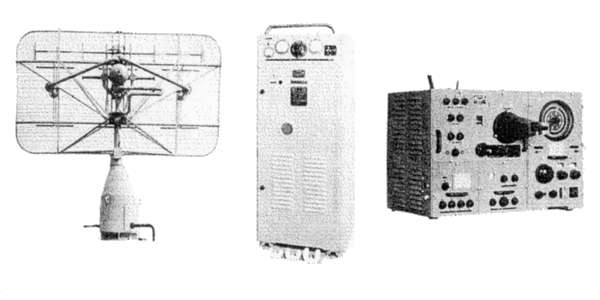
Figure 1: SA, SA-1

| Specifications | |
|---|---|
| frequency: | 175 … 225 MHz
(VHF band) |
| pulse repetition time (PRT): | |
| pulse repetition frequency (PRF): | 60 Hz |
| pulsewidth (τ): | 5 µs |
| receiving time: | |
| dead time: | |
| peak power: | 150 kW |
| average power: | 42 W |
| instrumented range: | 200 NM (≙ 300 km) |
| range resolution: | 460 m; 15° |
| accuracy: | |
| beamwidth: | 30° |
| hits per scan: | |
| antenna rotation: | 2.5 or 5 r.p.m. |
| MTBCF: | |
| MTTR: | |
SA, SA-1
SA, SA-1 was operating in the VHF band (IEEE designation) or in the A band (NATO designation) early long-range air surveillance and surface search radar designed for use in Destroyer Escort (DE) and larger ships.
The SA-1 type is a slightly lighter version. It’s angular accuracy is slightly worse due to the omitted possibility of lobe-switching.
The antenna is a flat grid-shaped reflector with the dimension of 1,6 × 2,6 m. It is fed with 6 horizontally polarized dipoles (2h × 3w) via coaxial cables. Echo signals are shown on a 5-inch A-scope.
Series production began in 1941. A number of 1565 sets were produced up to 1945.
Source:
- Military Standardization Handbook, United States Radar Equipment Manual TM 11-487C-1 1965, p. 1408f