
AN/APS-120
Description of the radar set, tactical-technical characteristics
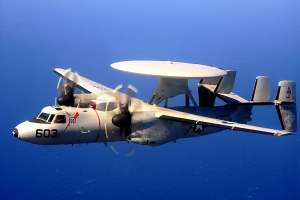
Figure 1: E2C with the APA-171 rotodome of the radar AN/APS-120

 Manufacturer:
General Electric
| Specifications | |
|---|---|
| frequency: | 406 … 450 MHz
(UHF band) |
| pulse repetition time (PRT): | |
| pulse repetition frequency (PRF): | 298 … 303.5 Hz |
| pulsewidth (τ): | 12,8 µs |
| receiving time: | |
| dead time: | |
| peak power: | 1 MW |
| average power: | 3.8 kW |
| instrumented range: | 200 NM (≙ 370 km) |
| range resolution: | |
| accuracy: | |
| beamwidth: | 6.6° |
| hits per scan: | |
| antenna rotation: | 6 rpm |
| MTBCF: | 18 hrs |
| MTTR: | 8 hrs |
AN/APS-120
AN/APS-120 is operating in the UHF band airborne Air & Surface Search, Long-Range Pulse Doppler early warning radar used in Northrop-Grummans E2B and E2C Hawkeye.
The block diagram of the radar is identical to the predecessor types AN/APS-96 and AN/APS-111 (XN-1). The antenna was located in a radome above the aircraft fuselage with a diameter of 7 feet and a height of 2.5 feet. It consisted of a group of horizontally polarized Yagi antennas connected as a monopulse antenna. The fully coherent transmitter used a coaxial amplitron as a power amplifier. The radar signal processing used pulse compression down to a pulse duration of 0.2 µs.
The radar AN/APS-120 was operational in 1970 and was replaced in 1976 by the AN/APS-125.
Source:
- D.F. Hemenway, B.N. Navid, “Reliability of Naval Radar Systems”, NAVAL RESEARCH LABORATORY, Washington, D.C., 1978