
PAWR
Description of the radar set, tactical-technical characteristics
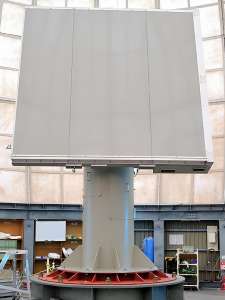
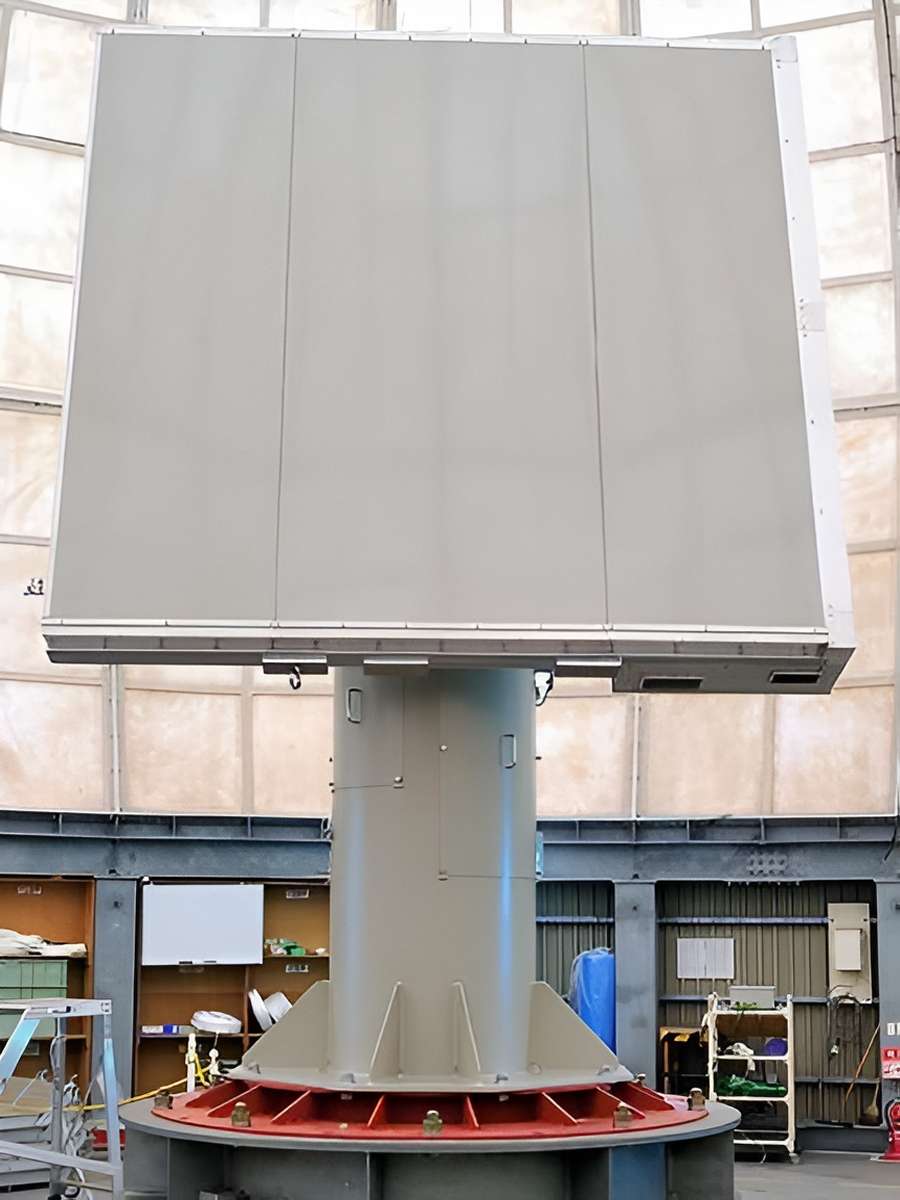
Figure 1: PAWR

| Specifications | |
|---|---|
| frequency: | 9 320 … 9 445 MHz
(X band) |
| pulse repetition time (PRT): | |
| pulse repetition frequency (PRF): | |
| pulsewidth (τ): | |
| receiving time: | |
| dead time: | |
| peak power: | |
| average power: | |
| instrumented range: | 60 km |
| range resolution: | 100 m |
| accuracy: | |
| beamwidth: | 1.2° |
| hits per scan: | |
| antenna rotation: | 2 or 6 min⁻¹ |
| MTBCF: | |
| MTTR: | |
PAWR
The PAWR (Phased Array Weather Radar) is a short-range precipitation radar operating in the X band (IEEE designation), also known as the I band (NATO designation).
The antenna is a phased-array antenna measuring 2 × 2 m. It consists of 128 rows, each equipped with a slotted waveguide antenna. Each of the lower 24 rows uses a transmit/receive module, while each of the upper 104 rows has its own independent receiver. During transmission, a broad fan beam is radiated in elevation. The 128 receiving channels are connected to a digital beamforming processor that simultaneously generates up to 100 separate receive beams at different elevation angles. A complete three-dimensional volume scan is produced in approximately 30 seconds during one mechanical rotation of the antenna in azimuth.
The first PAWR was commissioned on the roof of Osaka University in 2012. Two more PAWR systems were installed in 2014: one at the Advanced ICT Research Institute in Kobe, and the other at the Okinawa Electromagnetic Technology Center in Onna Village (Kunigami District).
Sources: