
Beijing MST Radar
Description of the radar set, tactical-technical characteristics
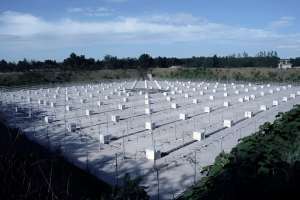
Figure 1: Beijing MST Radar

| Specifications | |
|---|---|
| frequency: | 50 MHz
(VHF band) |
| pulse repetition time (PRT): | 160 or 320 μs |
| pulse repetition frequency (PRF): | |
| pulsewidth (τ): | 1 or 4 µs |
| receiving time: | |
| dead time: | |
| peak power: | 172 kW |
| average power: | |
| instrumented range: | |
| range resolution: | 160 m or 320 m |
| accuracy: | |
| beamwidth: | 3.2° |
| hits per scan: | |
| antenna rotation: | |
| MTBCF: | |
| MTTR: | |
Beijing MST Radar
Beijing MST Radar is operating in the VHF band mesosphere–stratosphere–troposphere (MST) radar. It is used to investigate the structure and the variabilities in the tropopause in Xianghe, China, with a temporal resolution of 0.5 hours. The radar was designed and constructed by the Institute of Atmospheric Physics, Chinese Academy of Sciences, and started its routine operation on 20 October 2011.
The antenna array consists of 24 × 24 3-Element Yagi antennas. Five beams are applied: one vertically pointed beam and four 15° off-zenith beams tilted to the north, east, south, and west. The radar is designed to operate routinely in three separate modes:
- low mode (range: ≈ 2,5 to 12 km, vertical resolution: 150 m),
- middle mode (range: ≈ 10 to 25 km, vertical resolution: 600 m), and
- high mode (range: ≈ 60 to 90 km, vertical resolution: 1 200 m).